Among the new displays was the Department of Innovation and New Weapons Systems, part of the Defense Ministry’s “Agenda 2030” and its new Deterrence Doctrine. Yet the show of military strength came amid growing frustration in Athens: the realization that, despite billions spent on defense, Europe’s so-called allies continue to arm its main regional rival — Turkey.
The Mitsotakis government had set two major defense goals in recent years: to prevent Turkey from acquiring U.S.-made F-35 fighter jets, and to stop European partners from supplying Ankara with advanced weaponry. Both objectives now appear to have failed. Turkey is reportedly close to finalizing a deal for the F-35s — a sharp reversal from the political “triumph” that Prime Minister Kyriakos Mitsotakis was celebrated for after his address to the U.S. Congress in 2022, when many Greek media outlets portrayed his visit as a historic diplomatic success.
Meanwhile, President Recep Tayyip Erdoğan is moving ahead with the purchase of Eurofighter jets, as confirmed by British Prime Minister Keir Starmer. The program is a joint production involving not only the United Kingdom but also Germany, Italy, and France — the same France that has sold Greece Rafale fighters and Belharra frigates and has pledged to stand “shoulder to shoulder” with Athens in any confrontation with Turkey.
The developments underscore a stark reality that Greek officials privately admit: defense programs in Europe are not primarily driven by national interests, but by NATO’s strategic planning and the commercial priorities of the continent’s defense industries. “Countries sell weapons for profit, not for the sake of international law,” a senior Greek defense analyst commented this week, reflecting widespread skepticism in Athens about the value of alliances based on arms purchases.
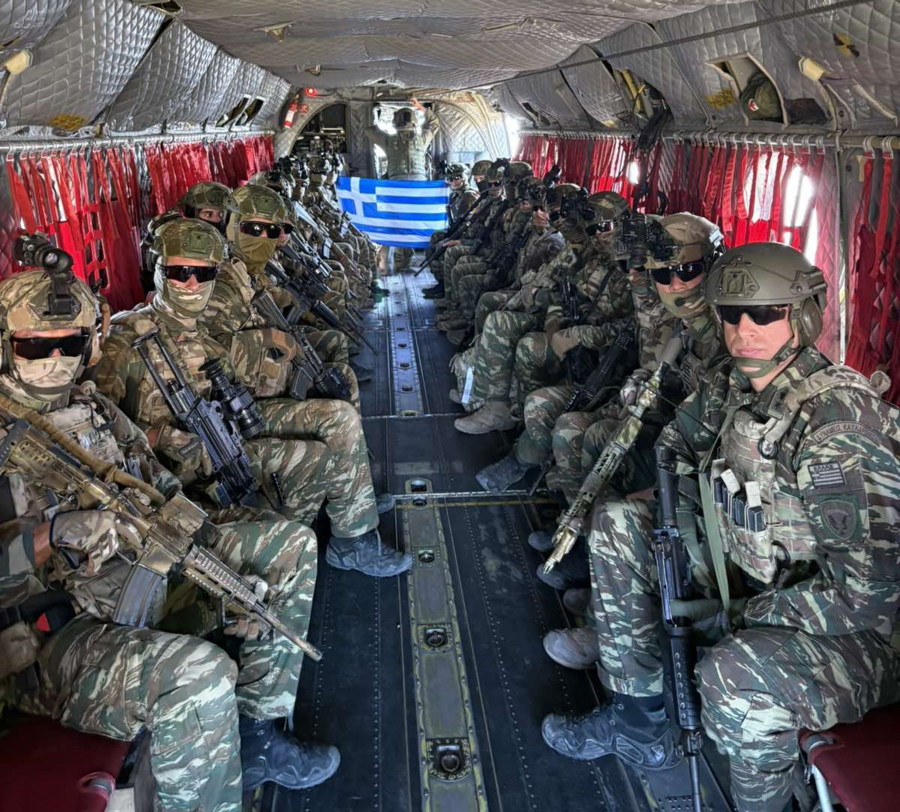
Still, Greece presses ahead with its own modernization drive. The Thessaloniki parade offered a glimpse of what Defense Minister Nikos Dendias calls “the most powerful and modern armed forces in the history of modern Greece.” The centerpiece was the so-called “Achilles’ Shield” — an integrated defensive network combining unmanned systems, surveillance technologies, and digital command-and-control platforms designed to provide multi-layered protection on land, sea, and air.
Among the systems presented was the Israeli-made Heron drone, used for border surveillance and capable of 40-hour flights at altitudes exceeding 30,000 feet. The Greek Army also displayed U.S.-made M1117 armored reconnaissance vehicles equipped with locally produced electronic sensors and cameras that transmit live battlefield data. Another highlight was the Spike NLOS precision missile system, capable of striking targets up to 32 kilometers away and supported by the Orbiter drone for real-time reconnaissance.
Equally notable were the new counter-drone technologies. The Kentavros system, developed by the Hellenic Defense Innovation Center and the Hellenic Aerospace Industry, can detect and disable enemy drones through electronic interference. Already deployed on Hellenic Navy frigates operating in the Red Sea as part of the “Aspides” mission, the system has reportedly achieved “excellent results.” A more advanced version, called Hyperion, is under development and offers 360-degree autonomous protection against aerial threats.
Greece also unveiled a range of domestically developed platforms, including the Archytas unmanned aircraft — a collaboration between the Hellenic Naval Academy, the National Technical University of Athens, and private companies. With vertical takeoff and landing capabilities, it can operate from both land and sea, reaching altitudes of 5,000 meters with two hours of autonomy. The A900 unmanned helicopter, used aboard naval vessels, and the VTR unmanned speedboat, developed by the military’s Research and Innovation Center, further demonstrate Greece’s ambition to achieve greater technological autonomy.
Behind the parade’s spectacle lies a clear strategic message: Greece intends to be less dependent on foreign suppliers and more capable of producing and maintaining its own defense systems. The country’s first mobile drone production units, equipped with 3D printing technology, can manufacture up to 1,000 small FPV drones annually on the battlefield. New mobile command centers, communication hubs, and disaster-response units such as the Deucalion system round out a defense ecosystem that merges traditional deterrence with high technology.
For Athens, however, modernization is as much about political symbolism as military necessity. As Europe deepens its defense cooperation and NATO presses its members to increase spending, Greece finds itself caught between alliance obligations and regional realities. Its biggest threat remains a fellow NATO member, one increasingly courted by the same powers that arm Greece itself.