A new strategic report by European cybersecurity firm Sekoia.io raises serious questions about the effectiveness of international sanctions against the surveillance software industry. Titled «Predators for Hire: A Global Overview of Commercial Surveillance Vendors», the report shines a spotlight on Intellexa, the company behind the notorious Predator spyware, which was extensively deployed in Greece.
According to the findings, Intellexa remains fully operational in 2025, continuing to expand its reach through a network of companies and intermediaries to conceal its activities - despite U.S. sanctions and repeated public revelations about its practices.
The Sekoia.io study traces the rise of commercial spyware vendors from 2010 to 2025, presenting Intellexa as a prime example of a sector that thrived in legal grey zones and triggered mounting international concern over democracy and fundamental rights.
Founded by Tal Dilian, a former head of an Israeli cyber-intelligence military unit, Intellexa rapidly built a global presence through subsidiaries, partners, and brokers in multiple countries. Its flagship product, Predator, is considered one of the most invasive mobile surveillance tools available: it enables complete access to a target’s phone, interception of calls and messages, remote activation of microphones and cameras, and real-time location tracking.
Crucially, the report highlights that Predator was not only used against serious criminals or terrorists but also targeted journalists, political opponents, and activists - often without judicial approval - turning it into a tool of political repression.
Leaked documents in 2022 revealed that Predator’s use on up to 100 devices cost around €8 million, underscoring both its profitability and the strong demand among state clients. Intellexa struck deals with governments across Europe, the Middle East, and Africa, often in countries with weak oversight and limited freedoms. Despite sanctions announced by the United States in 2023 and 2024, the report concludes that Intellexa’s operations were not significantly hindered.
A key part of Intellexa’s strategy, according to Sekoia.io, is the deployment of layered proxy networks and front companies to obscure its tracks. Predator’s infrastructure relies on multi-level server systems designed as «layers of anonymity» to shield end clients. By 2025, investigators identified five distinct anonymization layers, with the fifth linked to Czech firm FoxItech s.r.o. While not officially listed under the Intellexa group, the company shows ties to Israeli businessman Dvir Horef Hazan, known for managing multiple entities that received payments from Intellexa. FoxItech owner Michal Ikonomidis was also found to have possible connections.
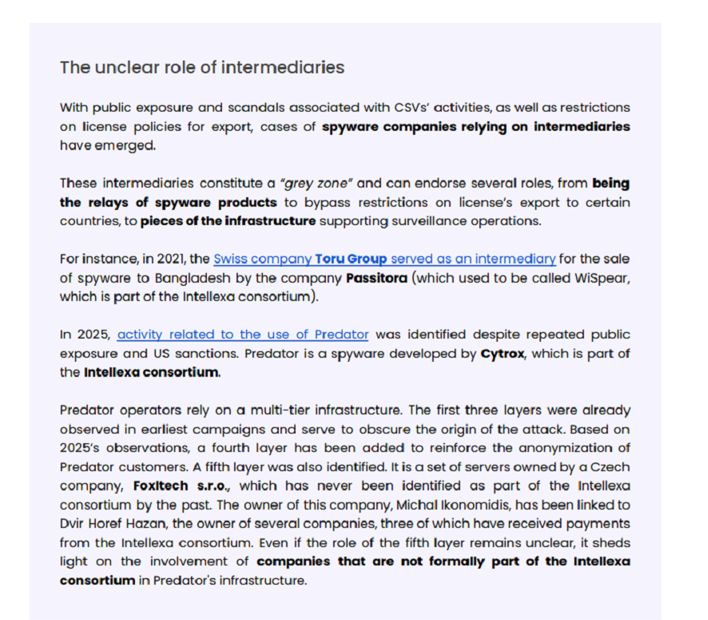
The report stresses that such intermediaries are critical to the spyware ecosystem. They not only enable sales in restricted markets but also provide servers, infrastructure, and technical support that make attribution far more difficult. One cited case is that of Swiss-based Toru Group, which in 2021 brokered spyware sales to Bangladesh on behalf of Passitora (formerly WiSpear), a company linked to Intellexa’s network.
Sekoia.io also notes Intellexa’s attempts at image management after each scandal: rebranding subsidiaries, creating new legal entities, and relocating staff and operations to jurisdictions with weaker controls. These maneuvers allowed the company to weather political and legal pressure while continuing business as usual.
The report concludes that the commercial spyware industry has systematically exploited loopholes in international law. The pressing question now, it argues, is whether the global community will be able to establish clear, binding rules for the use of such technologies. Far from retreating, Intellexa has evolved into a more complex and concealed network, generating profits while allegations of human rights abuses multiply.
Meanwhile, the trial over Predator-related surveillance in Greece has been scheduled before the Athens Misdemeanor Court on September 24, 2025, with defendants including Tal Dilian, Sara Hamou, Felix Bitzios, and Giannis Lavranos.