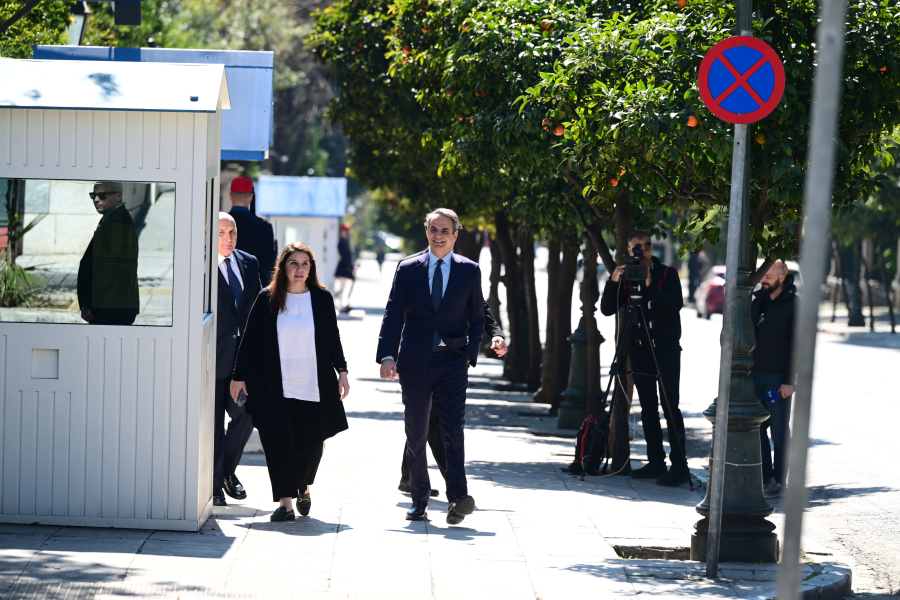

A key issue in these talks will be how much of Greece’s defense spending can be excluded from its deficit calculations. This, along with the country’s stronger-than-expected economic performance, will determine how much fiscal space the government has for tax cuts. Greek Prime Minister Kyriakos Mitsotakis is expected to announce new tax relief measures at the Thessaloniki International Fair (TIF) later this year.
The European Commission is set to finalize its position on Greece’s defense spending exemptions by March 19. The general proposal suggests that annual increases in defense spending will not count toward the budget deficit. However, the debate will center on what percentage of GDP should be used as a baseline for these exemptions.
If the EU sets the baseline at 2% of GDP, Greece—currently spending 3% of GDP on defense—would gain an additional 1% of GDP in fiscal leeway, or roughly €2.45 billion ($2.65 billion). If only the year-on-year increase in defense spending is considered, the fiscal space would be smaller, around €860 million ($930 million).
Regardless of the outcome, Greece will need to amend its Medium-Term Fiscal-Structural Plan (MTFS) for 2025-2028, which has already been submitted to the European Commission. This means Brussels will likely demand offsetting measures to keep the country’s budget on track.
The current MTFS projects a 3.6% rise in primary government expenditures by 2026, with a primary surplus of 2.4% of GDP. Meanwhile, Greece’s public debt is expected to decline to 143.1% of GDP. However, annual public spending is already set to increase by roughly €2 billion ($2.16 billion)—with half going to operational costs and the rest to pensions—without any additional policy changes.
Reinstating the 13th and 14th salaries for public sector employees would cost an estimated €3 billion ($3.24 billion), exceeding the planned rise in government spending. To implement the measure, Athens would need either a major reallocation of current expenditures or an increase in tax revenue, as there is currently no fiscal space to accommodate it. If the EU allows Greece to exempt more defense spending, part of this cost could be covered. Otherwise, the government will need to introduce compensatory fiscal measures.
On taxation, the MTFS already includes scheduled reductions, such as a one-percentage-point cut in social security contributions in 2025, followed by another 0.5-point cut in 2027. However, there is no provision for lowering the income tax rate for middle earners (€10,001–€20,000), raising the tax-free threshold, or reducing the top tax rate of 44%—measures that have been proposed by opposition parties.