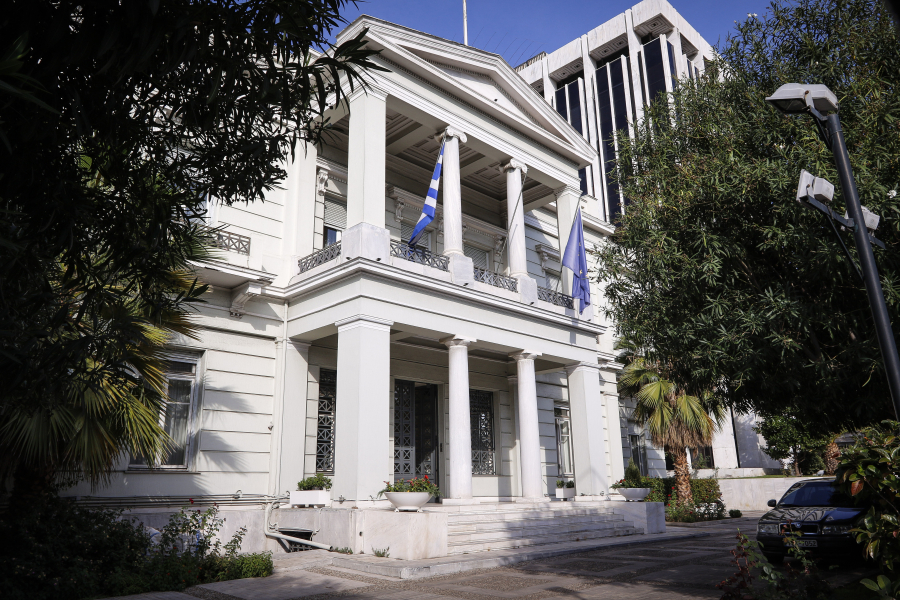
Greece rejected Libya’s parliamentary approval of a disputed maritime agreement with Turkey on Tuesday, warning that the move threatens regional stability and could complicate efforts to develop energy resources in the eastern Mediterranean.
The Greek Foreign Ministry said Tuesday, the decision by Libya’s House of Representatives to ratify the 2019 agreement wouldn't alter what Athens considers its unlawful status under international maritime law.
The agreement, signed between Turkey and Libya’s Tripoli-based government, establishes maritime boundaries across a stretch of the Mediterranean between the two countries.
ΔΙΑΒΑΣΤΕ ΕΠΙΣΗΣ



Greece disputes the arrangement because it doesn't recognize the maritime rights Athens claims for its islands, including Crete, which lies between the Turkish and Libyan coastlines.
“The geography and the international law of the sea cannot be changed by unilateral, legally unfounded parliamentary decisions,” the Greek Foreign Ministry said.
Athens argues that Turkey and Libya lack the geographical basis for the maritime boundary established by the agreement and that the arrangement infringes on the sovereign rights of other countries.
Turkey has defended its maritime claims in the region, where disagreements over continental shelves and exclusive economic zones have complicated relations among neighboring states.
Greece said it had informed its international partners and allies of the Libyan parliament’s decision and would take appropriate measures to protect its sovereign rights.
The ministry also called on Libya to avoid actions that could undermine stability in the eastern Mediterranean.
The dispute has implications for offshore energy exploration, particularly south of Crete, where Greece has sought to advance hydrocarbon development.
In August, Libya’s Tripoli-based government submitted a diplomatic protest concerning Greek exploration activities in the area.
Athens maintains that its maritime agreements with Egypt and Italy demonstrate its commitment to resolving boundary disputes in accordance with international law.
The Libyan parliament’s decision also prompted criticism of Prime Minister Kyriakos Mitsotakis’s government from Greek opposition figures.
Former Prime Minister Antonis Samaras criticized the government’s handling of relations with Turkey and Libya. Samaras accused Prime Minister Kyriakos Mitsotakis and Foreign Minister George Gerapetritis of mishandling relations with Libya, arguing that the parliamentary decision contradicted earlier government assurances about diplomatic progress.
The former conservative prime minister said the developments had seriously undermined Gerapetritis’s credibility and criticized Mitsotakis for retaining him as foreign minister.
Samaras also raised concerns about migration from Libya, Turkish influence in northeastern Greece and broader regional security, accusing the government of underestimating geopolitical risks.
The Greek Left Alliance (ELAS), the party founded by former Prime Minister Alexis Tsipras, also accused Mitsotakis of a foreign-policy failure, arguing that his government had failed to prevent the agreement and secure sufficient support from international allies.
Dimitris Mantzos and Yannis Maniatis, senior representatives of the opposition PASOK party, described the ratification as a negative development for Greece’s geopolitical interests.
They called for an immediate government briefing, arguing that the decision contradicted earlier assurances that maritime discussions with Libya were progressing positively.