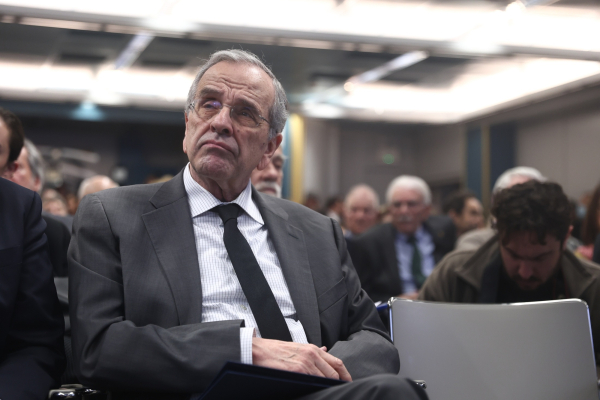

The question dominating conversations among ministers, lawmakers and party operatives is no longer whether former Prime Minister Antonis Samaras will challenge Mitsotakis from the right, but when.
For months, Samaras has escalated his attacks on the government, positioning himself as the voice of conservatives who believe New Democracy has drifted too far toward the political center. Behind the scenes, he has been quietly rebuilding political networks, reconnecting with local party bosses and sounding out potential allies across the country.
The prospect of a Samaras-led political vehicle has emerged as one of the most serious strategic threats facing Mitsotakis as he seeks to extend his dominance over Greek politics.
Unlike opposition parties on the left, Samaras does not need to win over new voters. His potential constituency already exists inside New Democracy's electoral coalition. Even a relatively small split on the center-right could complicate Mitsotakis' path to another outright parliamentary majority.
Nowhere is that threat more visible than in the Peloponnese, Samaras' political heartland. The former prime minister still commands a loyal network of local officials, activists and party veterans, particularly in his home region of Messenia, where his influence remains unrivaled.
According to several people familiar with internal party discussions, Mitsotakis' team is devoting significant resources to preventing defections before they happen. Local party structures have effectively become an early-warning system, tracking conversations between Samaras allies and regional political figures.
The competition has evolved into a shadow campaign.
Party insiders describe a pattern in which local officials approached by Samaras or his associates are quickly contacted by figures linked to the prime minister's office. The goal is not necessarily to persuade Samaras himself. It is to deny him the organizational infrastructure required to launch a viable political movement.
Yet even government officials acknowledge privately that this strategy has limits.
Samaras does not need hundreds of defections. He needs enough experienced political operators to establish credibility, build local organizations and offer disaffected conservatives a new political home.
That possibility comes at an awkward moment for Mitsotakis. While New Democracy remains comfortably ahead of its rivals, party polling suggests cracks are appearing within its traditionally disciplined voter base. Supporters who once viewed Mitsotakis as the uncontested leader of the Greek center-right are increasingly divided over issues ranging from migration and foreign policy to questions of national identity and government accountability.
The prime minister has responded by sending senior ministers across the country in an effort to reconnect with grassroots activists and shore up party morale. The campaign reflects a growing recognition that New Democracy's biggest challenge may not come from the fragmented opposition, but from forces emerging within its own political family.
Samaras is not the only source of concern. Former Prime Minister Kostas Karamanlis continues to command influence among traditional conservative networks, particularly in northern Greece. But party strategists see an important distinction.
Karamanlis can influence factions. Samaras could create a competing pole of power.
The breakdown in relations between Samaras and Mitsotakis extends far beyond policy disagreements.
One of the deepest fault lines remains Greece's surveillance scandal. In 2023, forensic analyses from Hellenic Data Protection Authority (HDPA) indicated that Samaras had been targeted in 2021 with Predator spyware, the same surveillance software that became the centerpiece of one of the biggest political controversies of Mitsotakis' tenure.
The Greek government has repeatedly denied purchasing or operating Predator. But the affair remains politically toxic because Tal Dilian, the owner of Intellexa, the company that marketed the spyware, has publicly stated that Predator was sold exclusively to state authorities rather than private individuals.
Samaras has repeatedly demanded a full explanation of how his phone came to be targeted and why the affair has never been fully clarified. Those questions remain unanswered.
The political symbolism is difficult to ignore. It was Samaras, as prime minister in 2013, who brought Mitsotakis back into frontline politics by appointing him minister for administrative reform, a position that launched the political ascent that would eventually take him to the premiership.