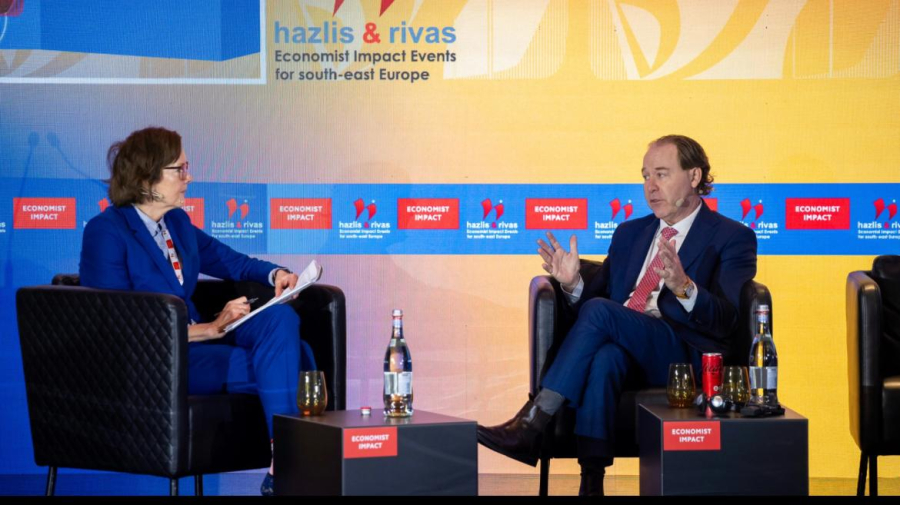

At an energy conference hosted by The Economist in Bucharest four weeks ago, American investor Seth Bernstein struck an optimistic tone about southeastern Europe, praising both Greece and Romania as fertile ground for investment. Introduced as a “leading international investor” and head of Bernstein Equity Partners, he also made a series of bold geopolitical predictions, telling the audience that the conflict in the Middle East would be resolved within weeks and that his personal acquaintance, Donald Trump, would steer the U.S. away from any prolonged military entanglement.
Mr. Bernstein framed U.S. foreign policy as part of a broader effort to rebalance global power, arguing that Washington’s actions are designed to curb the influence of countries such as China, Russia, Iran and Venezuela. He said such interventions also aim to limit illicit oil flows and combat drug trafficking networks that can destabilize entire regions.
His remarks drew attention, but it is his quieter activity in Greece that has begun to attract scrutiny. According to people familiar with the matter, Mr. Bernstein has made several visits to Athens since early 2026, holding meetings with government officials and business leaders. His introduction to senior circles was reportedly arranged by a well-connected Greek communications adviser seeking to establish a more direct line to figures perceived to be close to Mr. Trump, thereby broadening the government’s informal access to Washington.
Those meetings, however, appear to have yielded little concrete progress. People briefed on the discussions say Mr. Bernstein presented an expansive vision for potential investments, ranging from airports and energy infrastructure to publicly listed companies. The breadth of his proposals, described by some as overly ambitious, left officials wary of moving beyond preliminary talks.
At the same time, Mr. Bernstein maintained a favorable public stance toward Greece, praising the country’s leadership and economic direction during his Bucharest appearance. Behind the scenes, he is also said to have explored involvement in one of the country’s most consequential corporate developments: the planned capital increase of Public Power Corporation (PPC), the nation’s dominant electricity provider.
According to people with knowledge of the discussions, Mr. Bernstein submitted an alternative financing proposal for PPC’s investment program through 2030, potentially involving as much as €6 billion. The proposal was ultimately not pursued. Officials cited its complexity and cost, as well as concerns that it would have pushed the company’s leverage beyond acceptable levels. Supporters of the plan argue it might have reduced the burden on the Greek state, which is expected to contribute roughly €1.3 billion to the capital increase.
Mr. Bernstein’s growing visibility in Greece has prompted closer examination of his track record. Public records indicate that he has had connections with Mr. Trump and his family, but they also reveal a series of past legal and financial controversies that have drawn attention without resulting in criminal convictions.
A 2022 report by the New York Post described Mr. Bernstein’s involvement in two separate matters. In one, he reported the theft of a luxury Hublot watch in Barcelona, valuing it at more than $800,000. Spanish authorities, citing the manufacturer, estimated the watch’s worth at closer to $45,000. No charges were filed.
In the U.S., Mr. Bernstein was linked to the bankruptcy of private aviation company JetReady, which filed for protection in 2020 with millions of dollars in unpaid debts. A bankruptcy trustee sought to investigate transfers exceeding $1.6 million made by Mr. Bernstein before the filing, and a judge authorized subpoenas to examine the transactions. In a separate civil matter, allegations of improper use of pandemic relief funds under the Paycheck Protection Program were settled in 2021 without any admission of wrongdoing.
More recently, his firm has been drawn into an ongoing legal dispute with a former executive, Eduardo Irrera, who alleges he was misled about the company’s scale and financial strength when he accepted a senior role in 2021. The lawsuit, now proceeding in New York, includes claims of fraudulent inducement and breach of contract. The company denies the allegations, and the case remains unresolved.
None of these matters has resulted in a conviction, but together they have raised questions among some observers about the due diligence conducted by those who facilitated Mr. Bernstein’s access to senior policymakers in Greece.