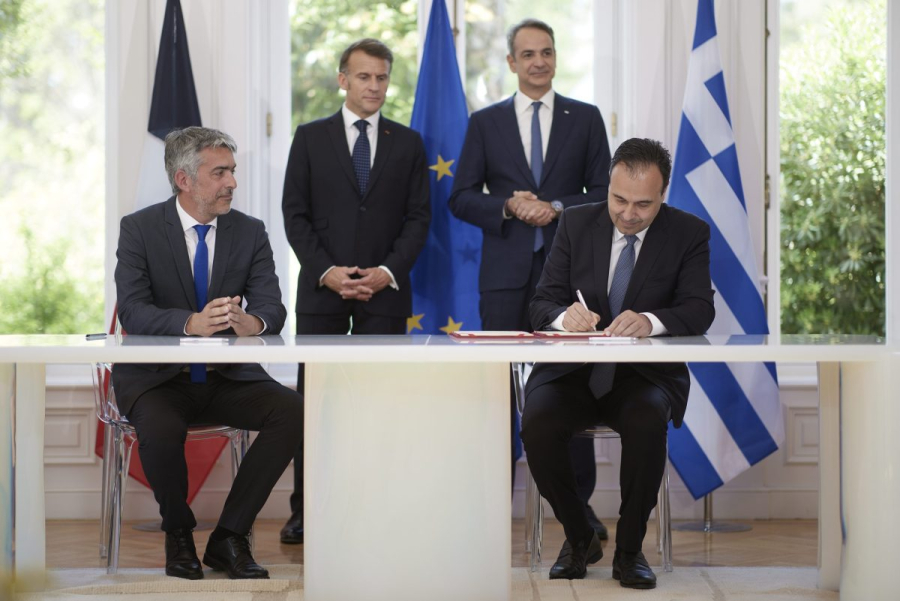
Greece has signed on to a new international initiative aimed at reshaping how oceans are monitored and managed, becoming the third country to back the creation of the International Mercator Ocean Centre alongside France and Norway.
The agreement, signed during a visit to Athens by French President Emmanuel Macron, marks a step toward establishing what backers describe as the first intergovernmental organization dedicated to operational digital ocean systems—tools that use real-time data and advanced modeling to track and manage marine environments. The initiative reflects a broader European push to harness high-resolution data for decision-making across shipping, environmental protection and the so-called blue economy, as policymakers seek more precise ways to balance economic activity with sustainability goals. Supporters say digital ocean platforms could improve maritime safety, strengthen climate monitoring and provide governments with more reliable data on everything from fisheries to pollution.
By joining France and Norway as a founding participant, Greece is positioning itself to play a role in shaping the organization’s strategic direction. The country brings significant maritime credentials to the table, including one of the world’s largest commercial shipping fleets and a long-standing presence in ocean research. Greek officials say the country plans to contribute technological infrastructure, including artificial-intelligence systems, high-performance computing and satellite capabilities, to support the development of what is known as a “Digital Twin of the Ocean”—a virtual model designed to simulate and predict ocean conditions.
Speaking during the signing, President Macron framed the agreement as part of a widening partnership between Paris and Athens that extends beyond defense into environmental and digital cooperation. Greece’s participation, he said, strengthens efforts to build shared capabilities around ocean data and governance. Greek Digital Governance Minister Dimitris Papastergiou said the country intends to play a substantive role in the new body, citing its strategic location in the Eastern Mediterranean and its expertise in maritime industries. He described the initiative as aligned with Greece’s broader push to expand its role in data-driven public services and emerging technologies.
Pierre Bahurel, head of Mercator Ocean International, said Greece’s accession represents a “decisive step” toward bringing the organization into force, adding that its maritime experience and technical capacity would strengthen the project. The effort comes as governments worldwide face growing pressure to better manage oceans that are increasingly affected by climate change, overfishing and rising geopolitical competition. Proponents argue that digital monitoring systems could become a cornerstone of future ocean governance, though questions remain about funding, data-sharing and global coordination as the initiative moves from concept to implementation.