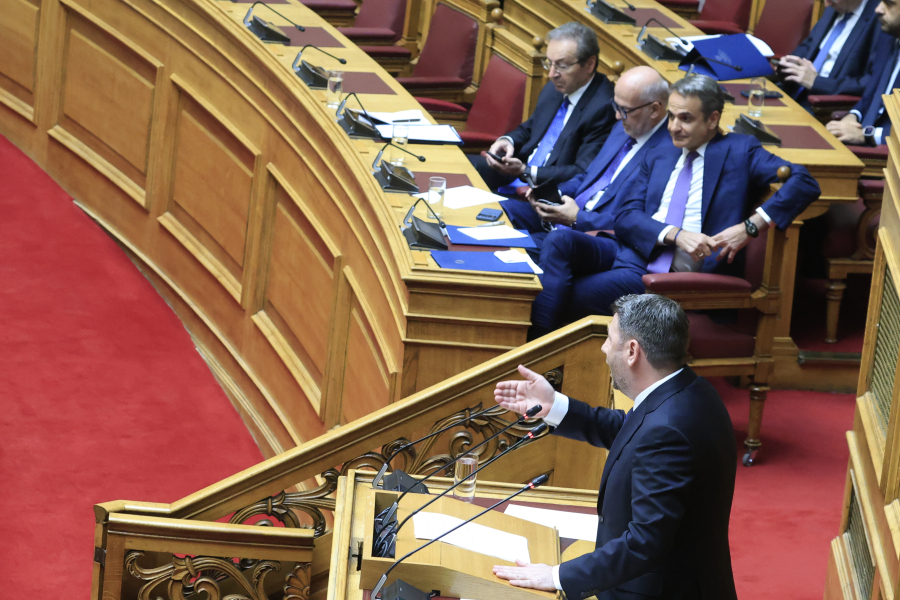
As Greece’s parliament debated the state of the rule of law on Thursday, the country’s long-running wiretapping scandal returned to the center of political confrontation, exposing fresh divisions over one of the most damaging controversies of Prime Minister Kyriakos Mitsotakis’ tenure.
Under pressure over new allegations tied to the Predator spyware affair, Mitsotakis declined to offer substantive answers on the latest developments and instead sought to dismiss the credibility of Tal Dilian, the Intellexa chief linked to the spyware network. “This Dilian, Dylan — whatever his name is,” the prime minister said from the parliamentary floor, adding that his government “will not be blackmailed by anyone convicted at first instance.”
The remarks drew an immediate backlash from Nikos Androulakis, leader of the center-left PASOK party and one of the most prominent known surveillance targets in the scandal. Androulakis urged Greek judicial authorities to summon Dilian without delay and compel him to submit any evidence he claims to possess showing that Predator was supplied to the Greek government and law enforcement agencies.
“Who is behind the para-state?” Androulakis asked, in a direct challenge aimed at both Mitsotakis and Dilian, escalating accusations that the surveillance operation may have involved actors close to the Greek state.
Androulakis also attacked the judicial management of the case, saying the investigation had been marred by serious failures and delays. He pointed to a recent decision by the Single-Member Misdemeanor Court to send aspects of the case back for further investigation, despite earlier prosecutorial findings that no evidence linked the Greek state to Predator. He warned that continued delays by prosecutors risk allowing potential criminal offenses to expire under statutes of limitation.
In some of his sharpest remarks, Androulakis alleged that the Mitsotakis government had turned Greece’s National Intelligence Service, EYP, into “a side operation for Lavranos and Dilian,” directly tying the country’s intelligence apparatus to figures associated with the spyware network.
He also renewed demands for answers over the surveillance of senior Greek officials, including Foreign Minister Nikos Dendias, the chief of the armed forces, the head of the police, and judicial officials, asking how such extensive monitoring could have occurred without triggering major institutional consequences.
Mitsotakis, for his part, accused opposition parties of undermining the judiciary by attacking the leadership of the Areios Pagos, Greece’s Supreme Court, which he said would ultimately determine responsibility in the case.
Opposition parties rejected that argument, accusing the government of attempting to shift responsibility onto the courts while presenting itself as detached from a scandal that has drawn repeated scrutiny from European institutions and rights groups over the state of democracy and rule of law in Greece.
Communist Party leader Dimitris Koutsoumbas accused the government of engaging in “evasions, sleights of hand, and a cover-up,” while Zoë Konstantopoulou, leader of Course of Freedom, said Mitsotakis had failed to provide testimony in any of the major scandals in which he bears political responsibility, including the wiretapping affair.