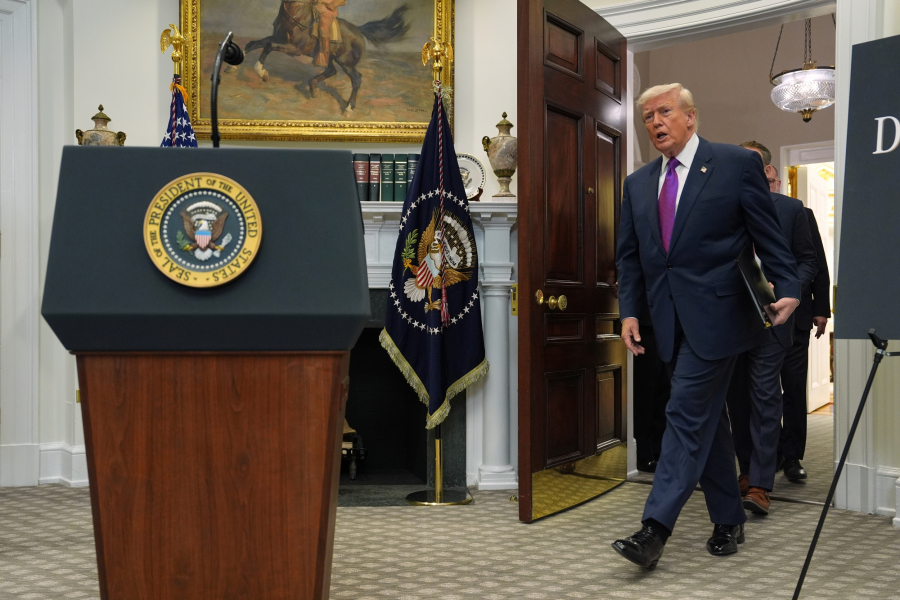

Intense behind-the-scenes activity is unfolding in relations between Greece and the United States, not through formal institutional channels but via the unconventional route often favored by U.S. President Donald Trump: initiatives led by trusted figures from his inner circle who operate informally, on the ground, and often away from established diplomatic frameworks.
According to converging information from Athens and Washington reported by the Greek daily To Vima, Richard Grenell—one of Trump’s closest foreign policy advisers and a presidential special envoy—was recently in Athens on a private visit. Grenell, a former U.S. ambassador to Germany and Washington’s representative in the Serbia–Kosovo negotiations, has long been considered a key figure in Trump’s nontraditional approach to diplomacy. He had been named in media reports last summer as part of a purported U.S. effort to encourage convergence in Greek–Turkish relations, allegedly in coordination with U.S. Ambassador to Greece Kimberly Guilfoyle and the U.S. ambassador to Turkey, Tom Barrack—an involvement Grenell publicly denied at the time.
Although his visit was unofficial and has not been formally acknowledged, Grenell is believed to have held a series of meetings in Athens with senior government figures and business leaders, though no details of the agenda have been disclosed. His professional focus on international negotiations, coupled with his proximity to the U.S. president, has fueled speculation about the broader significance of his presence. He reportedly arrived in Greece shortly before traveling on to Munich for the annual Munich Security Conference, where U.S. Secretary of State Marco Rubio was a central participant. Greece was represented at the conference by Energy Minister Stavros Papastavrou, and there are indications that Grenell may return to Athens privately in the coming days.
During the same period, Athens also hosted Paolo Zampolli, another presidential special envoy, whose portfolio spans international cooperation in culture and sports. Zampolli, an Italian-born businessman with longstanding personal ties to Donald Trump and First Lady Melania Trump, met with Greek Energy Minister Papastavrou on the sidelines of a geopolitical conference in Athens. Their discussions reportedly focused on Greek–American cooperation in the energy sector, in the presence of Ambassador Guilfoyle. The timing is notable, as Greece is set to sign concession agreements granting U.S. energy giant Chevron exploration rights to four offshore blocks, in a ceremony expected to be attended by Prime Minister Kyriakos Mitsotakis and Chevron’s senior leadership.
Zampolli also held meetings with Greece’s shipping minister and deputy sports minister and is said, according to reliable sources, to have had a brief earlier discussion with Prime Minister Mitsotakis on issues including child protection in the digital sphere, although the prime minister’s office has not confirmed such a meeting. Zampolli later traveled to Munich as part of the delegation accompanying Secretary of State Rubio. Sources familiar with his visit note that he has been tasked with coordinating international celebrations marking the 250th anniversary of the signing of the U.S. Declaration of Independence in 1776, events that will be organized worldwide by U.S. embassies as part of the “America 250” initiative.
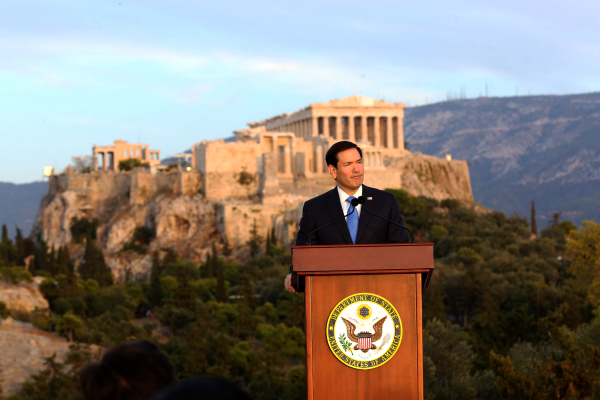
Greek officials and interlocutors have formed the impression that the U.S. ambassador in Athens is planning an especially high-profile Independence Day event this year, likely to be held outside the confines of the ambassadorial residence. This follows earlier remarks by the ambassador, made last November, in which she said she could envision a future U.S. president delivering a speech against the backdrop of the Acropolis.
Against this backdrop, speculation has resurfaced about a possible visit by Donald Trump to Greece. While current planning foresees the U.S. president traveling to Ankara in early July for a NATO summit, and Ambassador Guilfoyle recently hinted at a stop in Greece, neither American nor Greek officials have confirmed such plans. Traditionally, U.S. presidents visiting Turkey have often included Greece in their itineraries, though Trump has frequently departed from established diplomatic customs.
What is firmly on the agenda, however, is an expected visit by Secretary of State Marco Rubio to Athens in the context of the next round of the U.S.–Greece Strategic Dialogue. Although official channels indicate that preparations have not yet begun, senior sources suggest the visit could take place in the near future, possibly in the spring.
All of this is unfolding as the Greek government navigates a delicate balancing act between maintaining close ties with Washington and remaining firmly anchored within the European Union and the principles of international law that have traditionally guided Greek foreign policy. This tension was evident in recent deliberations in Athens over whether Prime Minister Mitsotakis should attend the inaugural session of a Peace Council in Washington at President Trump’s invitation.
Athens has made no secret of its desire for a more direct line of communication with the White House, rather than relying primarily on ministerial contacts or the U.S. embassy. In this context, the private presence in Greece of two of Trump’s special envoys is widely seen as evidence of both a shift in how bilateral relations are being managed and the level of U.S. interest in developments in the country. At the same time, officials are acutely aware that within Trump’s political ecosystem, attention is often secured not through diplomatic formalities but through concrete business opportunities—and, ideally, fully formed deals ready for approval.