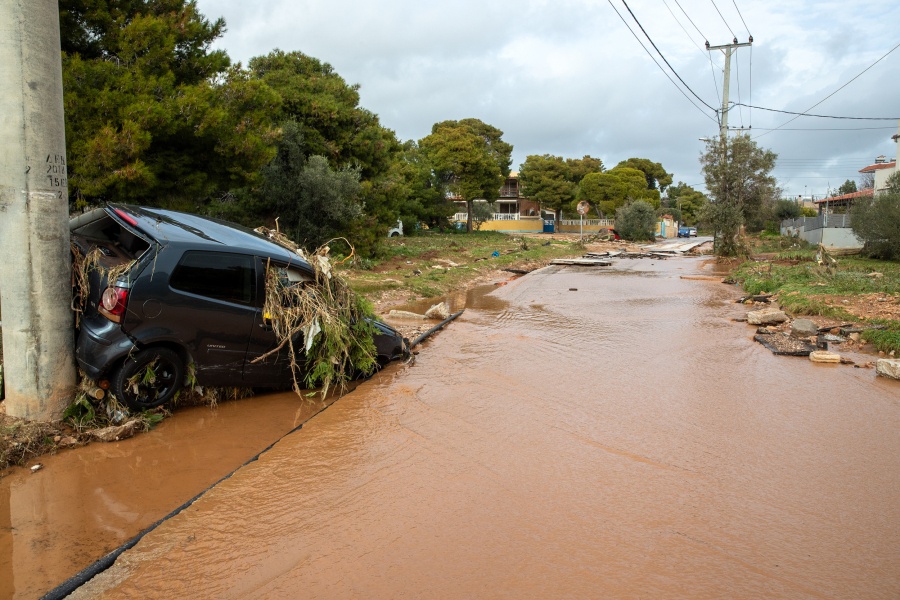

Natural disasters impose a heavy toll on economies, disrupting production, damaging infrastructure, and putting public finances under severe pressure. Yet new research suggests that, beyond the immediate shock, post-disaster reconstruction spending can become a meaningful driver of economic growth. A recent study by the Bank of Greece highlights how well-targeted public investment after extreme natural events can help transform crisis into opportunity over the medium term.
The study analyzes data from 116 advanced, emerging, and developing economies over the period 1990–2022. Its findings show that extreme natural disasters - such as major floods, earthquakes, or hurricanes - have more severe and longer-lasting negative effects on GDP than large but less destructive shocks. Developing economies tend to suffer the most pronounced damage, reflecting weaker infrastructure, lower fiscal buffers, and more limited access to financing.
In the short run, the economic impact is unambiguously negative. Output declines, public revenues fall, and government budgets deteriorate as emergency spending and repair costs rise. These immediate effects weigh on primary fiscal balances and constrain economic activity. However, the analysis finds that the medium-term dynamics can look very different when governments respond with targeted reconstruction policies.
Once automatic fiscal reactions are excluded, increases in public spending devoted specifically to rebuilding infrastructure and restoring productive capacity can deliver sizable growth gains. According to the study, a 1% rise in real, cyclically adjusted government spending following an extreme natural disaster is associated with an increase of around 2.5% in real GDP over a five-year period. This suggests that reconstruction efforts, if designed effectively, can generate economic multipliers that more than offset the initial shock.
The positive effects of reconstruction spending are not uniform across countries. They tend to be stronger in economies with lower public debt, less exposure to international trade, more developed financial systems, and fixed exchange rate regimes. Emerging economies appear to benefit the most, outperforming both advanced and least-developed countries. Researchers attribute this to larger infrastructure gaps and a greater need for investment after disasters, which allows reconstruction spending to have a more transformative impact.
The study concludes that natural disasters carry undeniable social and economic costs, often with long-lasting consequences. Nonetheless, timely and well-planned reconstruction policies can limit these losses and support medium-term growth, provided they are implemented with fiscal discipline and strategic focus. In this sense, rebuilding after disaster is not only about recovery, but also about laying the foundations for more resilient and productive economies.