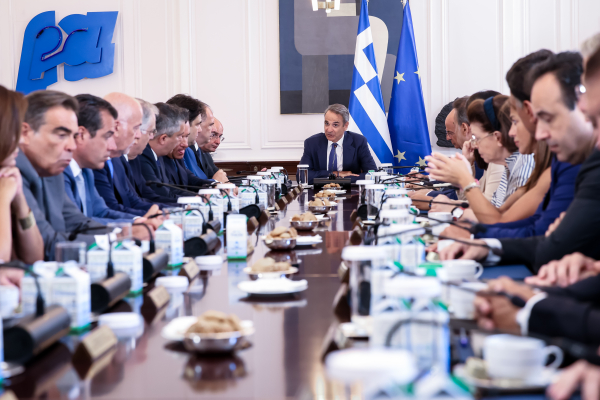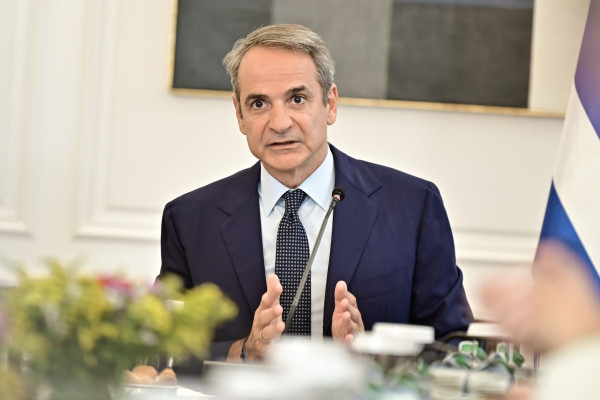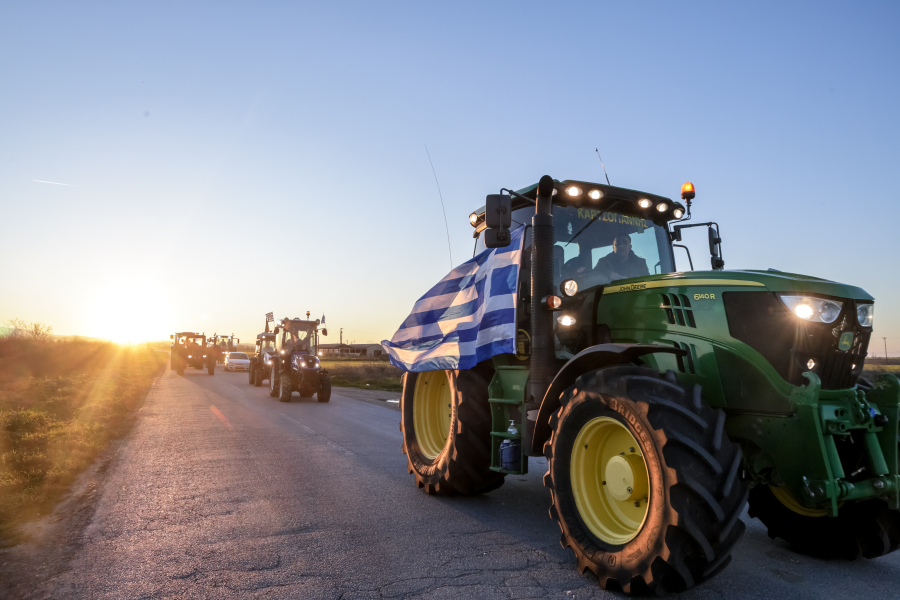

Farmers across Greece are hardening their stance against the government, rejecting a scheduled meeting with Prime Minister Kyriakos Mitsotakis on Tuesday and warning that their protests are likely to intensify in the coming days.
Major farmers’ roadblocks in the central regions of Nikaia and Karditsa announced on Monday that they would not attend talks with the prime minister, arguing that the government has refused to recognize the representatives chosen by the nationwide farmers’ movement. The farmers say the proposed meeting framework undermines the possibility of meaningful dialogue and is designed to weaken their collective front.
At the heart of the dispute is the government’s decision to divide discussions into two separate meetings, each limited to 20 participants. Farmers aligned with the Nationwide Roadblocks Committee insist that they had agreed internally on two specific negotiating committees—one representing crop producers and another representing livestock farmers, fishermen, and beekeepers—but claim the government rejected this structure. As a result, they argue that the talks would amount to a procedural exercise rather than a serious attempt to address the sector’s problems.
In Karditsa, protesting farmers decided to remain at their roadblock and wait until Wednesday morning for a possible change in the government’s position. Should no such shift occur, they are calling for an immediate nationwide coordination meeting to decide on further escalation. Farmers there accuse the government of acting in bad faith, claiming it is seeking to clear roadblocks and fragment the protest movement rather than offer concrete solutions.
Similar conclusions were reached at the Nikaia roadblock, where farmers also rejected participation in the talks unless the composition of the delegations changes. Protest leaders in both areas argue that the government’s approach amounts to a deliberate effort to divide the movement by engaging with alternative or breakaway groups.
Kostas Tzellas, head of the United Federation of Agricultural Associations of Karditsa, described the government’s strategy as a “rigged game,” telling farmers gathered at the E65 highway roadblock that the administration had no genuine intention of dialogue. He criticized the plan to hold two meetings only hours apart, saying it trivializes issues that directly affect farmers’ livelihoods and survival. According to Tzellas, the government’s priority is not resolving farmers’ demands but dissolving their mobilizations.
The government rejects accusations of manipulation. Speaking on Monday, government spokesperson Pavlos Marinakis said that the prime minister cannot operate under what he described as ultimatums. He explained that two meetings were scheduled because some farmer representatives refused to sit in the same room with others, and that participation limits were imposed for security and efficiency reasons. The government, he said, remains open to meeting all representatives of the protests.
Despite these assurances, opposition to the meeting is spreading. Roadblocks in Malgara and Promachonas have also rejected the invitation, with farmer representatives indicating readiness to escalate their actions. The Nationwide Roadblocks Committee formally announced that it would not attend the talks under the current conditions, arguing that the government’s refusal to accept their representative bodies makes meaningful negotiation impossible.
Government sources insist the dual-meeting approach was not intended to split the movement but to accommodate internal divisions among protesting groups. Farmers, however, see the move as confirmation of their fears that the government is attempting to legitimize splinter groups and weaken collective bargaining power.