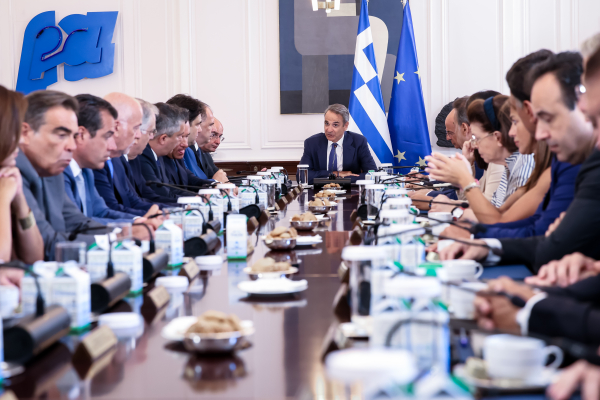


The Ministry of National Economy and Finance this week published the long-awaited call for binding offers from investors shortlisted to establish and operate the Sale-and-Leaseback Real Estate Agency, a central pillar of the country’s private debt management framework.
Once this final stage of the tender is completed, a preferred bidder is expected to be selected and awarded the contract to set up and run the Agency. The scheme was conceived as a safeguard for primary residences, allowing financially distressed households to remain in their homes as tenants after transferring ownership to the Agency, with an option to repurchase at a later stage. Yet its implementation has been repeatedly delayed, following a drawn-out and often problematic procurement process marked by cancellations, re-tendering, limited competition and successive deadline extensions.
The legal framework was adopted in 2020, at a time when Greece was seeking to put in place a stable and credible system for addressing private debt in the aftermath of successive economic crises. Despite the urgency attached to the reform, the first concrete attempt to implement the project came only in June 2022, when the initial tender notice was sent for publication in the Official Journal of the European Union. Although the call was quickly published at national level, the market response was negligible. Even after an extension of the deadline, no admissible bids were submitted, forcing the authorities to cancel the procedure in August 2022.
A relaunch followed almost immediately, under compressed timelines. This second attempt attracted interest, but the process soon became complex and time-consuming. Numerous clarification requests, procedural steps and formal decisions eventually led, in November 2022, to the preselection of candidates and the transition to a competitive dialogue phase, during which the detailed terms of the concession were to be shaped.
That dialogue proved lengthy and slow. Substantive discussions began in early 2023, focusing on technical, financial and legal aspects of the project. The process was repeatedly interrupted by requests for extensions and postponed deadlines, reflecting both the complexity of the scheme and the challenges of aligning public policy objectives with investor expectations. One of the preselected participants was ultimately excluded for failing to engage actively in the discussions. A second round of dialogue, centred on the draft concession agreement, did not begin until January 2024 and was again accompanied by multiple extensions.
It was only in October 2024—almost four years after the law was passed and two years after the tender was relaunched—that the competitive dialogue was formally concluded and approved by the contracting authority. This week’s publication of the call for binding offers, following a further delay of more than a year, finally moves the project into its decisive phase.
The context, however, has changed markedly since the scheme was first conceived. The number of participants has narrowed, timelines have stretched far beyond initial expectations, and the social and economic environment has evolved significantly. Investors still in the process include Bain Capital Credit, Christofferson, Robb & Co, LLC, Fortress Credit Corp., and Resolute Cepal Greece S.A., the latter having emerged from the earlier consortium of Kaican Hellas and Beaumont Summit Financial DAC.
Under the terms of the invitation, binding offers must be submitted by 23 February 2026. Requests for clarifications may be filed until mid-February 2026, while bids will be opened electronically a few days after submission. Offers will remain valid for 12 months, with scope for extensions under specified conditions.
The financial proposals are expected to define the core economic parameters of the scheme. Bidders must accept in full the final version of the concession agreement, with no room for renegotiation after submission. The offers will set out, among other elements, the profit margin embedded in the rent paid by borrowers who remain in their homes, as well as the way gains or losses will be shared between the Agency and the former owner if a property is eventually repurchased at a price different from its original acquisition value. A critical component is the minimum capital commitment, which cannot be less than €100 million, signalling that the project is aimed at investors with substantial financial capacity.
One notable absence from the final stage is LCM Capital LLP, which was excluded during the competitive dialogue. The decision was not based on technical shortcomings or failure to meet eligibility criteria, but on the company’s lack of active participation in the dialogue process. Despite repeated extensions and formal warnings, the firm did not engage substantively in discussions, leading the tender committee to conclude that this behaviour constituted a material breach of the rules governing the procedure.