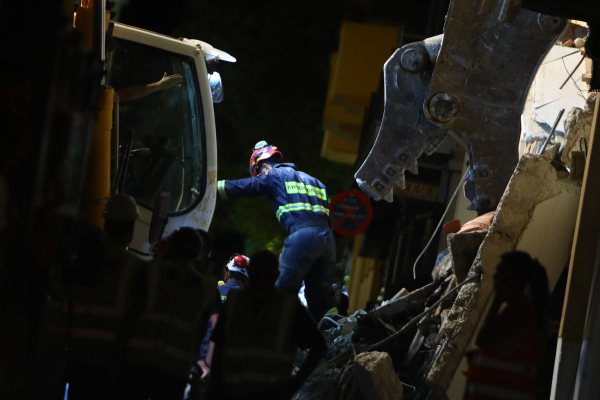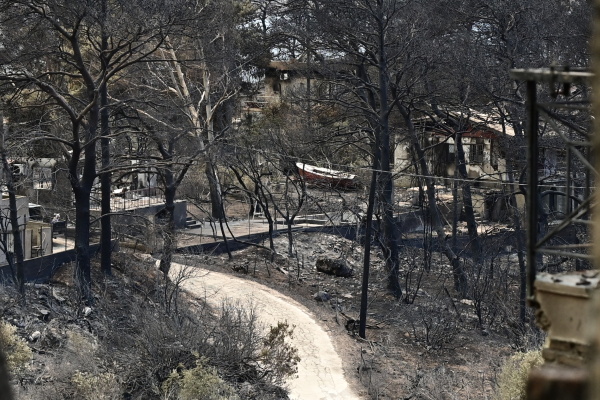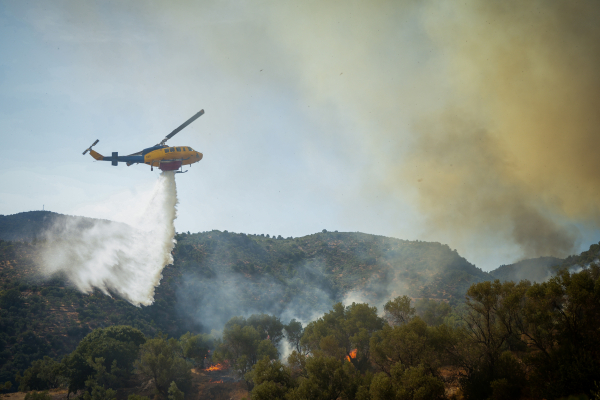
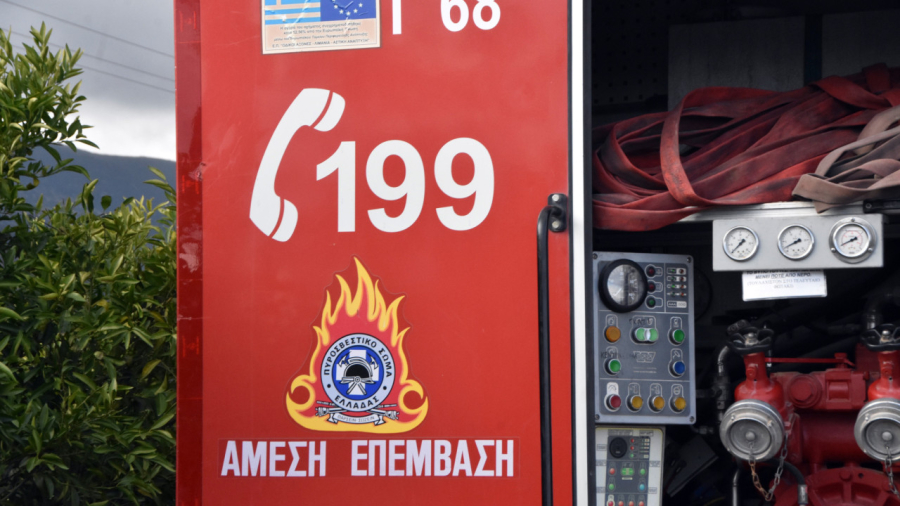

Memories of the deadly 2011 explosion at Mari, Cyprus, were rekindled on Saturday afternoon in the coastal town of Lavrio, Greece, when a fire broke out at the facilities of the state-owned Hellenic Defense Systems (EAS). The blaze, which caused widespread alarm among residents, was eventually brought under control following the rapid response of the Fire Service, which dispatched six vehicles to the scene.
According to accounts from workers, EAS management had allegedly attempted to decontaminate the soil by spreading lime in order to neutralize explosive residues that had polluted the site. The procedure, however, appears to have triggered ignition, sparking the fire. The situation could have been catastrophic, as roughly 220 tons of TNT and explosive remnants are believed to be stored within the facility.
Lavrio’s mayor, Dimitris Loukas, and EAS chief executive Christoforos Boutsikakis rushed to the scene shortly after the fire broke out. Reportedly, EAS attributed the incident to «spontaneous combustion,» though the exact cause will be determined by the Fire Service’s official report. The Lavrio–Eastern Attica Workers’ Union issued a strongly worded statement condemning what it described as delays in the delivery of special firefighting foam used for hazardous materials. The union demanded immediate transparency from both government authorities and EAS management regarding the cause of the fire and the materials that burned, noting that thick black smoke had blanketed Lavrio for several minutes, making the atmosphere suffocating. It also called for urgent safety measures, warning that, after recent revelations about hundreds of tons of hazardous waste remaining on the site, the risk of another environmental and human disaster «not only persists but is growing.»
The incident has drawn further attention to the long-standing delays in the decontamination of the Lavrio facilities. For months, the site has been at the center of an unresolved cleanup effort, following revelations that more than 180 tons of explosives remain buried underground, while another 40 tons are being stored temporarily in containers. The project is considered extremely hazardous and technically complex, and two major Greek industrial groups—Polyeco, owned by Yiannis Polychronopoulos, and V Group, owned by Vyron Vassiliadis—have reportedly expressed interest in undertaking it.
Polyeco has prior experience with similar work, having previously cooperated with the Czech firm MSM, a subsidiary of the CSG Group, to remove TNT contamination from the same site. However, the cost of the new project remains unclear, with estimates ranging from 5 million to 17 million euros, raising questions about the management and actual needs of the operation.
The pollution at Lavrio traces back to the Hellenic Defense Systems’ involvement in the destruction of anti-personnel mines after Greece signed the Ottawa Treaty in 2008. Under Contract 34/2008, the project was initially assigned to the Bulgarian company Videx, but it was halted in 2014 following a serious accident. Two years later, in 2016, the Greek company Soukos Robots took over the task. According to complaints and lawsuits filed in 2018, Soukos Robots is believed to be responsible for extensive soil contamination with TNT residues. To date, no clear explanation has been given regarding how the process was supervised.
At the end of 2024, shortly before stepping down, former EAS chief executive Nikos Kostopoulos announced a tender for the site’s decontamination. Yet, just two weeks after assuming his post, new CEO Christoforos Boutsikakis canceled the process and requested a new technical study, which eventually led to calls for yet another, more specialized one. As a result, the project has remained stalled and the site effectively abandoned.
Against this backdrop, the Lavrio plant’s management reportedly took it upon itself to accelerate the neutralization process by spreading lime on the contaminated ground—an unauthorized action that led to the ignition and the subsequent fire.
The incident has provoked strong reactions both locally and within the defense sector. In addition to the Municipality of Lavrio, the Czech CSG Group, which operates at the facility, is said to have expressed concerns over the safety of its personnel and to have requested immediate intervention from the Greek Prime Minister’s Office and the Ministry of National Defense.