
Despite a surge in liquefied natural gas (LNG) imports and booming exports, Russian natural gas continues to dominate Greece’s energy system. Data from the Greek gas transmission operator DESFA for the first nine months of 2025 show that imports through the Sidirokastro entry point — which connects Greece to Bulgaria’s network — reached 25.46 terawatt hours (TWh). That figure represents 45 percent of total gas imports, even though it is 3.3 percent lower than in the same period of 2024.
The data underline that while European Union policies have driven efforts to diversify energy supplies since Russia’s invasion of Ukraine, Moscow remains an active and significant supplier to Greece. The established corridor through Bulgaria continues to make Sidirokastro a strategic gateway for the country’s gas system.
Greece’s total gas demand, including exports, rose sharply to 56.36 TWh during the period — a 16.7 percent increase year on year. Domestic consumption grew by 7.7 percent to 51.3 TWh, but the standout figure came from exports, which soared from 0.66 TWh last year to 5.06 TWh, a jump of 667 percent. Most exports flowed northward through regional interconnections, underscoring Greece’s growing role as a natural gas hub for the Balkans. This position has been further strengthened by the start of commercial operations at the Alexandroupolis floating storage and regasification unit (FSRU), connected to the national grid via the new Amphitriti pipeline.
Electricity generation remains the largest consumer of natural gas in Greece, accounting for 71 percent of domestic demand, or 36.45 TWh — a sign of the sector’s continued dependence on gas-fired power. By contrast, consumption by industry and compressed natural gas (CNG) stations fell by nearly 17 percent, representing just 11 percent of total demand. Residential and small-scale consumers, supplied through distribution networks, recorded an 18 percent increase, reaching 9.42 TWh.
While Russian gas still dominates, LNG has made notable inroads. Imports through the Agia Triada (Revithoussa) and Amphitriti (Alexandroupolis) terminals covered more than 40 percent of total gas imports, up from about 26 percent a year earlier. Revithoussa alone received 36 LNG cargoes — more than double the 17 in 2024 — despite being offline for almost three weeks of scheduled maintenance between May and June. Imported LNG volumes totaled 22.41 TWh, an 81.6 percent increase year on year.
The United States remained Greece’s largest LNG supplier, providing 19.62 TWh, or 88 percent of total LNG imports. Nigeria followed with 1.37 TWh, ahead of Norway with 0.93 TWh and Algeria with 0.49 TWh. The Alexandroupolis FSRU, which began commercial operations in early 2025, contributed 1.03 TWh before regasification services were temporarily suspended in July.
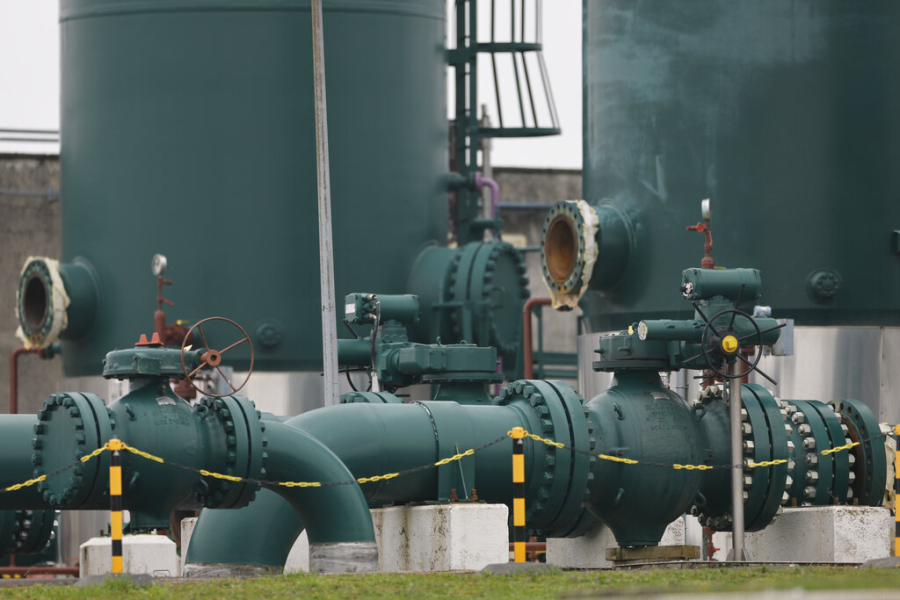
Despite lower volumes overall, Sidirokastro continues to serve as Greece’s main entry point for Russian gas. Flows through the station remain roughly five times higher than those from the Trans Adriatic Pipeline (TAP) interconnection at Nea Mesimvria, where throughput declined by another 14.7 percent to 8.2 TWh. The persistence of such volumes indicates that, despite Europe’s commitment to phase out Russian energy, existing infrastructure, competitive pricing, and fuel compatibility continue to make Russian gas an attractive option for Greek buyers.
Meanwhile, Greece’s LNG logistics network is expanding rapidly. Truck-loading operations at Revithoussa surged to 494 shipments and 148 gigawatt hours (GWh) transported, compared with 174 shipments and 51 GWh a year earlier — effectively tripling in volume. The service supplies remote regions and industrial clients, enhancing the flexibility of the national gas system.
DESFA has emphasized that its infrastructure serves as a “driving force of the energy transition,” helping diversify supply sources and strengthen energy security. Yet the figures make one point unmistakably clear: despite diversification efforts and the expansion of LNG capacity, Russian gas continues to play the leading role in Greece’s energy balance.