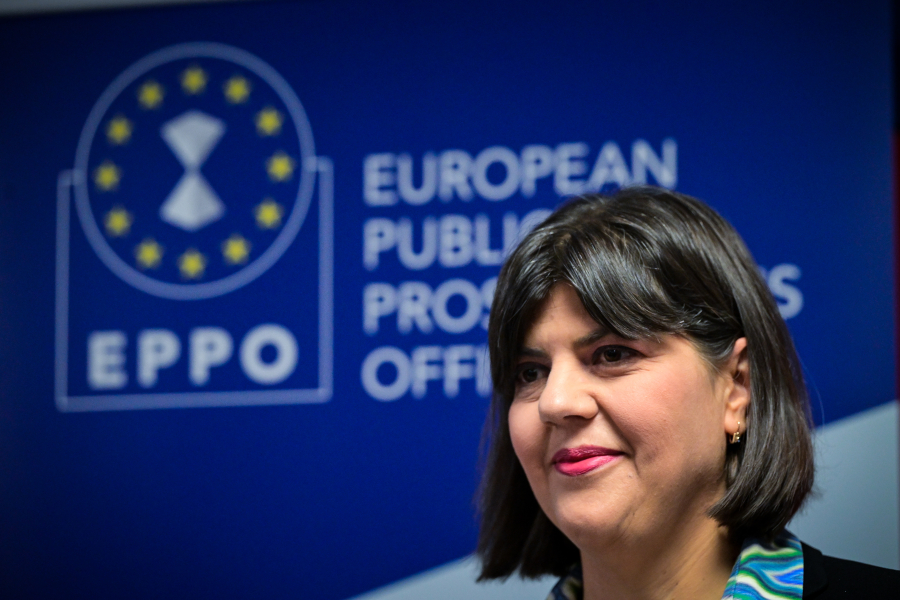
European Chief Prosecutor Laura Kövesi used a visit to Athens this week to send an uncompromising message: the European Public Prosecutor’s Office (EPPO) will not back down in its investigations, and the “rules of the game have changed.”
Her press conference, held at the Piraeus customs office, carried strong symbolism. It was here that Greek prosecutors and EPPO uncovered the EU’s largest recorded case of port tax fraud, seizing thousands of containers worth an estimated €250 million. Ten customs officials were arrested for allegedly taking bribes to look the other way. Kövesi warned that such schemes are no longer run by small-time smugglers but by organized crime networks, some with links to China, targeting the European market.
Turning to domestic scandals, she described Greece’s agricultural payments agency, OPEKEPE, as “an acronym for corruption, nepotism and clientelism.” She also criticized the country’s ministerial immunity law, Article 86 of the Constitution, which shields politicians from prosecution. She called for its abolition, saying it had blocked prosecutors investigating both OPEKEPE and the 2023 Tempi rail disaster, where 57 people were killed. Had a key safety contract been completed, she noted, the crash could have been avoided.
Kövesi strongly defended the work of EPPO’s Greek office, dismissing criticism from former OPEKEPE officials who labeled the body “dangerous.” Quoting mythology, she said it was time to “clean out the Augean stables.” She emphasized that her office operates beyond national borders, ensuring accountability where domestic politics may interfere.
Although she acknowledged that corruption is not unique to Greece, government-friendly outlets highlighted that remark to downplay her harsher comments. Prime Minister Kyriakos Mitsotakis has also shown irritation at EPPO’s scrutiny, recently complaining that “only in Greece is there so much noise” about the office.
Yet Kövesi’s stance left little room for doubt. She stressed that EPPO is permanent, determined, and immune to political pressure. “We will continue our work despite intimidation,” she said. Twice, she repeated the same line for emphasis: “The rules of the game have changed.”