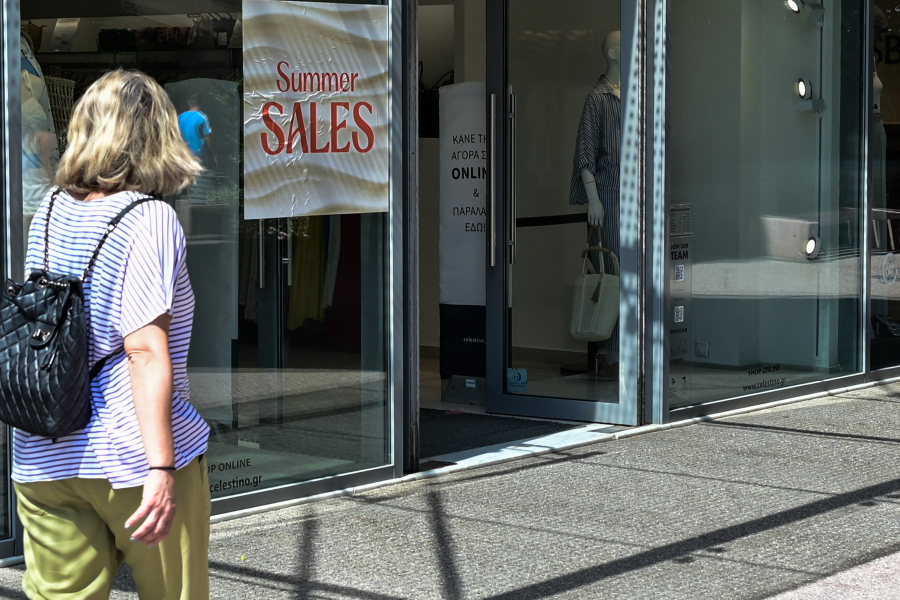

Greece’s retail sector saw a sharp decline in business sentiment in July, with the Retail Trade Business Expectations Index dropping to 93.4 points from 105.9 in June, according to the latest Economic Sentiment Survey by the Foundation for Economic and Industrial Research (IOBE). This downturn affects all key areas of retail, indicating a broad-based weakening of confidence across the sector.
One of the clearest signs of this shift is the steep fall in companies' views on their current sales performance, with the balance of responses plunging to +7 points from +35 the previous month. Expectations for sales over the next three months were also less optimistic, though the drop was more moderate, easing to +24 from +27. At the same time, new orders saw a significant boost, reaching +23 points, suggesting some forward-looking confidence. However, this was offset by a surge in inventory levels, which rose to +32 from +24, raising concerns about unsold stock accumulating. Employment expectations dipped slightly to +24 from +27, while inflationary pressures remained visible, as 14% of businesses anticipate price increases in the near term. Economic uncertainty also grew, with 72.5% of respondents saying that forecasting future growth is difficult or relatively difficult—up from 65.2% in June.
Looking more closely at specific retail categories, all recorded some degree of decline in sentiment. In the Food, Beverages, and Tobacco sector, the expectations index fell to 98.2 from 105.9 in June, now sitting below last year’s level of 103.7. While current sales expectations eased slightly to +25 from +34, projections for future sales improved modestly to +47 from +41. Inventories rose sharply to +23 from -2, and supplier orders strengthened significantly to +43 from +32. Notably, employment expectations improved strongly, reaching +70 points. Price expectations, though still elevated, moderated to +21 from +55, signaling some cooling in inflationary pressure.
In the Textiles, Clothing, and Footwear sector, the business sentiment index dropped to 73.3 points from 82 in June—dramatically lower than the 152.8 recorded during the same period last year. Companies’ assessments of current sales fell sharply to -59 from -26, while expectations for upcoming sales declined slightly to +35 from +42. Inventory levels decreased modestly to +48 from +61, and supplier orders swung sharply into positive territory at +42 from -24. Meanwhile, employment expectations improved substantially, rising to +40, and price forecasts moved slightly lower, suggesting potential price reductions ahead.
For Household Equipment, the index declined to 81.3 from 89.9, significantly below the 125.2 recorded a year ago. Negative assessments of current sales deepened to -33 from -16, while future sales expectations turned slightly negative at -1 from a previous +4. Inventory levels edged up to -2 from -8, and orders to suppliers weakened markedly to -11 from +20. Employment projections dropped to +5 from +11, and price expectations continued to point to moderate upward pressure, remaining at +7.
The Vehicles and Spare Parts sector also experienced a notable drop in sentiment, with the index falling to 93.1 in July from 112.0 the previous month, and from 106.6 in July 2024. Current sales expectations collapsed from +52 to -15, though forecasts for future sales improved significantly to +30 from +14. Inventory levels increased slightly to +49 from +45, and supplier orders returned to positive territory at +5 from -10. However, employment expectations declined to +6, and price forecasts remained mildly inflationary at +9.