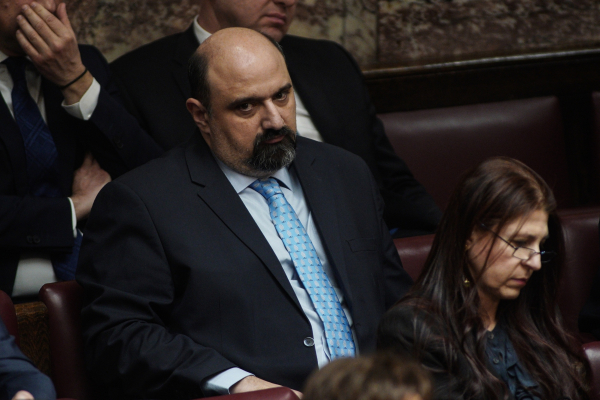


Speaking with Professor Xenophon Contiades, Rammos reflected on his six-year tenure, the wiretapping scandal that rocked the political establishment, and the systemic resistance he encountered while defending the independence of oversight institutions.
Rammos did not mince his words. From chronic underfunding and lack of staffing, to open political and institutional hostility during ADAE’s investigations into the Greek intelligence service (EYP), he described a system in which independent authorities are treated as inconvenient obstacles rather than essential guardians of democratic accountability. “ADAE is not a procedural body,” he said. “It does not serve political commands, and it does not filter the truth to make it more pleasant.” According to Rammos, the moment he took office it became clear that the mere existence of an independent authority made those in power uncomfortable.
The scandal exploded in the summer of 2022, when it was revealed that Nikos Androulakis, then a Member of the European Parliament and leader of the opposition PASOK party, had been under surveillance. Despite clear indications of wrongdoing and swift mobilization by ADAE, Rammos described an atmosphere that was institutionally stifling and hostile to transparency. His agency responded quickly, dispatching audit teams and investigating complaints. While many accusations proved unfounded, a significant number were verified. Throughout this period, he said, public discourse became increasingly toxic, filled with threats and media attacks. “There was a character assassination,” he said, noting that although his actions were grounded in legal precision, no official legal arguments were ever presented to challenge them.
Rammos shared startling statistics: in 2021 alone, more than 15,000 surveillance orders were issued in Greece for reasons of national security. Although the number dropped the following year, he highlighted a serious procedural gap: the orders lacked any documented justification, a clear violation of European legal standards that require surveillance decisions to include stated reasons. “A prosecutor cannot authorize such serious measures without evidence or explanation,” he said.
He expressed particular disappointment in the Greek Parliament’s response, especially from the Committee on Institutions and Transparency and the special parliamentary inquiry into the wiretapping scandal. Though summoned multiple times and presenting extensive documentation, Rammos said the majority treated him in a way that undermined the institutional gravity of the issue. “They wanted to reduce my testimony to a formality,” he said. “I refused to take part in what felt like a constitutional shadow play.”
Rammos also came under fire for testifying before the European Parliament’s PEGA and LIBE committees. Critics accused him of “internationalizing” domestic matters, but he responded unequivocally: he had been officially invited, and there is no legal or democratic prohibition on Greek citizens engaging with European institutions. He interpreted the backlash as part of a broader intolerance toward external accountability.
He was sharply critical of an opinion issued by the Greek Supreme Court’s Prosecutor, Isidoros Dogiakos, who argued that ADAE had no authority to investigate surveillance carried out for national security purposes. Rammos said the opinion not only overstepped legal bounds—since the Prosecutor is not empowered to issue binding interpretations on independent authorities—but was also accompanied by veiled threats, warning of potential charges of espionage and the disclosure of state secrets.
One particularly troubling moment, he recounted, was the unexpected and late-night replacement of ADAE board members shortly before a session in which the agency was expected to fine the EYP for non-cooperation. Rammos viewed this as a direct constitutional violation, particularly as the majority needed for the session was calculated through what he described as a legally dubious rounding method. When Greece’s highest administrative court, the Council of State, later rejected a challenge from the Athens Bar Association on the grounds that the association had no legal standing, Rammos warned that the ruling “opens the door to institutional impunity.”
Looking to the present and future, Rammos expressed deep concern over the recent creation of a new National Cybersecurity Authority, which effectively stripped ADAE of several of its core responsibilities without any consultation. Even Law 5002/2022, which directly reshaped the agency’s powers, was passed without ADAE’s input. He underscored the urgent need to modernize the agency’s legal framework, particularly to address new technological threats such as spyware and digital surveillance tools.
Rammos also highlighted major concerns about recent changes to the process of notifying individuals who have been placed under surveillance. This task was removed from ADAE and handed to a new three-member body—two of whose members are the very prosecutors who approved the surveillance in the first place. He questioned the independence and impartiality of such a mechanism.
In conclusion, Rammos offered a bleak assessment of the current state of rule of law in Greece. “Independent authorities are accepted only as long as they remain harmless,” he said. “When they become inconvenient, they are left entirely unprotected. But their mission, as defined by the Constitution, is to become inconvenient when necessary.”