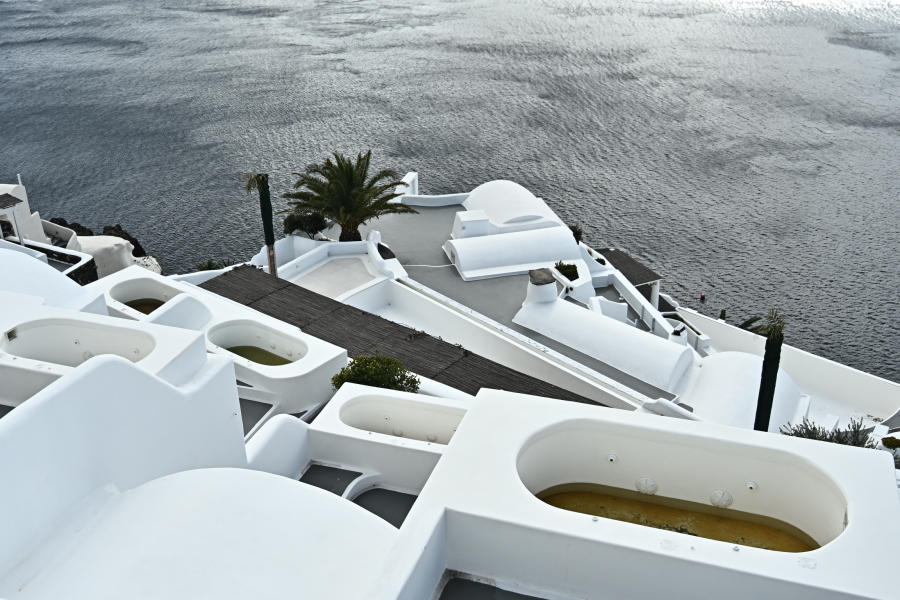
Once bustling with life, its streets now lie empty, its shops and cafés shuttered, as fear grips the local population. Nearly 11,000 people—mostly families with children—have fled by plane and ferry, seeking refuge on the mainland or nearby islands.
Amid the exodus, only a few elderly residents remain, reluctant to abandon their lifelong homes. A handful of tourists, undeterred by the tremors, wander Santorini’s iconic alleys, seizing the rare chance to experience its beauty without the usual crowds.
On Wednesday night, the strongest earthquake in recent days, measuring 5.2 in magnitude, struck the sea area between Santorini and Amorgos. The tremor, recorded at a depth of 11.2 kilometers, had its epicenter 16 kilometers southwest of Arkesini, a village on Amorgos.
The Athens Geodynamic Institute confirmed that this was the most powerful quake of the ongoing sequence.
Dr. Thanasis Ganas, the institute’s Director of Research, noted that the tremor originated from the same seismic zone as the previous day's 5.0-magnitude quake and suggested that the pattern is characteristic of a seismic swarm. While this could indicate that the region is releasing energy gradually rather than through a single massive quake, other experts have warned that the increasing magnitude of tremors remains a cause for concern.
Efthymis Lekkas, Professor of Seismology and President of the Earthquake Risk Assessment Committee, suggested that a larger quake, potentially reaching 5.5 in magnitude, remains a possibility.
A report from the National and Kapodistrian University of Athens (EKPA) issued an alarming statistic: more than 6,400 earthquakes have been recorded in the Santorini-Amorgos region between January 26 and February 3.
Scientists believe this activity fits the pattern of a seismic swarm, where no single earthquake stands out as the dominant event. While some projections indicate that the number and intensity of tremors may gradually decrease, others suggest that the swarm could trigger a rupture in a major fault in the region, leading to a more powerful main earthquake.
Seismologists emphasize that these quakes are occurring within the active South Aegean Volcanic Arc, though they do not appear to be directly linked to a known volcanic center. Instead, the tremors seem to have activated a fault system running from the southwest to the northeast beneath the seabed near the small uninhabited islet of Anydro.
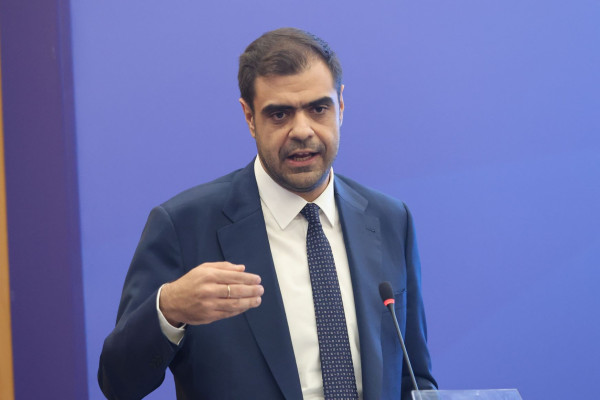
Greek Prime Minister Kyriakos Mitsotakis attended an emergency briefing on Wednesday at the Ministry of Climate Crisis and Civil Protection, where leading scientists and officials discussed the ongoing seismic crisis.
Professor Kostas Papazachos, a geophysics and seismology expert, explained that while the fault line has already ruptured significantly, some unbroken sections remain that could still produce stronger tremors. However, he suggested that the overall situation may be improving.
«Residents will continue to feel tremors, but the scenario appears to be moving in a more favorable direction», he reassured.
Professor Evi Nomikou from the University of Athens urged Santorini’s residents to remain calm, stressing that scientists are closely monitoring the situation and that the current epicenters are located far from the fault that triggered the devastating 1956 earthquake in the region.