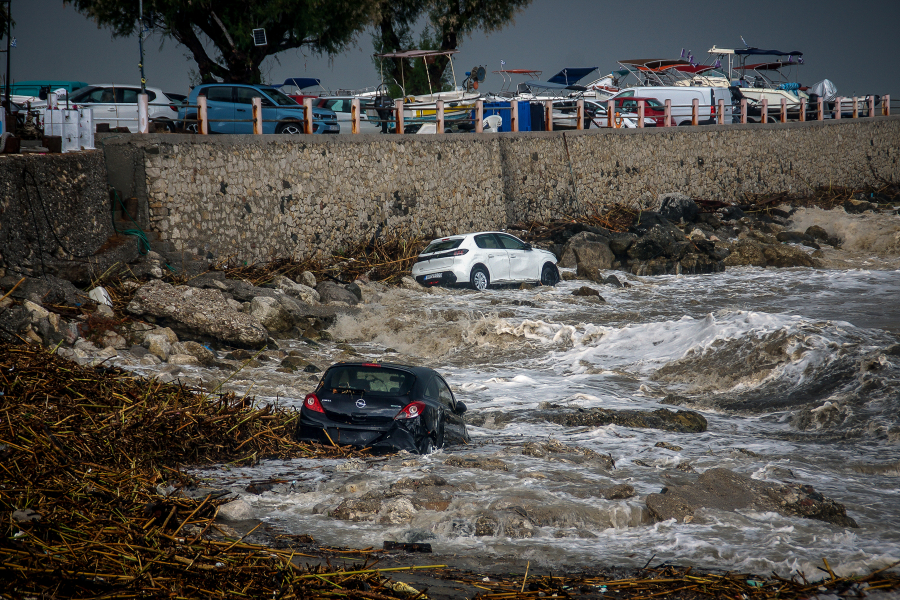
A powerful storm that swept across Greece left one person dead and caused extensive flooding and infrastructure damage on several popular tourist islands, as emergency crews struggled Wednesday to contain the destruction from torrential rainfall and gale-force winds.
The worst damage was reported on Rhodes, a major tourist destination in the southeastern Aegean Sea, where a 62-year-old hotel worker died after floodwaters swept his vehicle into the sea near the coastal village of Stegna.
Local residents discovered his body among reeds and debris. Authorities said the man, originally from northern Greece, apparently attempted to escape his vehicle as rapidly rising waters overwhelmed the area.
ΔΙΑΒΑΣΤΕ ΕΠΙΣΗΣ



Rhodes recorded 202 millimeters, or nearly eight inches, of rainfall in approximately six hours, according to the National Observatory of Athens.
Greece's fire service received 204 emergency calls across Rhodes, Evia and the greater Athens region between Tuesday evening and Wednesday afternoon. On Rhodes alone, firefighters responded to 113 incidents, pumping water from flooded properties and moving 13 people to safety.
Severe flooding also struck Evia, Greece's second-largest island, northeast of Athens, where overflowing rivers prompted evacuation alerts and damaged critical road connections.
Authorities declared parts of the island's Dirfys-Messapia municipality in a state of emergency after floodwaters submerged roads and threatened residential areas. A key road linking Prokopi and Mantoudi became impassable after flooding from the Kireas River.
The National Observatory recorded 295 millimeters of rainfall in Steni, Evia, over two days, the highest total measured nationwide during the storm.
Emergency warnings were also issued for Skiathos, a popular holiday island in the Sporades archipelago, where residents were urged to restrict travel to essential journeys.
Greek authorities placed several regions on heightened emergency alert, including parts of the Aegean, Crete and the Peloponnese.
Meteorologists said the storm was weakening across much of the country Wednesday evening, although heavy rainfall remained possible in eastern and southern areas. Northerly winds reaching force nine on the Beaufort scale continued to threaten maritime travel.
Conditions are expected to improve Thursday, with weaker winds and diminishing rainfall, although showers could persist over Crete.
Another weather system is forecast to arrive between Friday and Saturday. While meteorologists expect less intense rainfall, authorities remain concerned that additional precipitation could worsen flooding in areas where rivers are already swollen and infrastructure has been damaged.