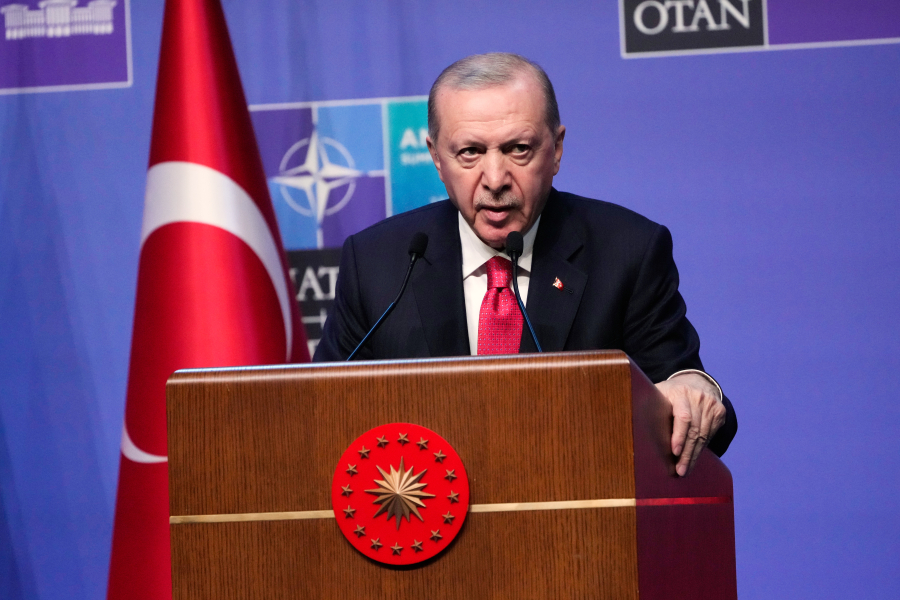
Turkish President Recep Tayyip Erdogan issued a fresh warning to Greece on Tuesday over the military status of islands in the Aegean Sea, reviving one of the most sensitive disputes between the two neighboring NATO members.
Erdogan said Greece should end what Turkey considers the militarization of islands governed by international agreements restricting their military presence. He also cautioned Athens against interpreting Ankara’s measured approach as a sign of weakness.
“Anyone who interprets Turkey’s calm and prudent stance as weakness is making a serious mistake,” Erdogan said, according to Turkish media. “Greece must abandon the militarization of islands that have demilitarized status.”
ΔΙΑΒΑΣΤΕ ΕΠΙΣΗΣ



The comments highlight the persistence of tensions beneath a period of relative calm in Greek-Turkish relations. Greece and Turkey have spent decades at odds over territorial waters, airspace, maritime boundaries and the military status of islands in the Aegean.
Turkey argues that Greece has violated treaty provisions by stationing military forces and equipment on certain eastern Aegean islands. Greece rejects Ankara’s interpretation and says its defensive posture is justified by security concerns stemming from Turkey’s military presence on the nearby Anatolian coast and the broader strategic relationship between the two countries.
Erdogan escalated his language when asked Tuesday how Turkey would respond if Greece continued to militarize islands that Ankara considers subject to demilitarization requirements.
“What should we do? What is our duty? To do what is necessary,” he said.
The Turkish president then made an indirect reference to Kastellorizo, a small Greek island situated just off Turkey’s Mediterranean coast. The island, known as Meis in Turkey, lies only a few kilometers from the Turkish town of Kas and has assumed considerable geopolitical importance because of competing Greek and Turkish positions over maritime jurisdiction in the eastern Mediterranean.
“If we raised our voice from our side, say from Kas toward Greece, they would hear it, wouldn’t they?” Erdogan said.
He added that Ankara had approached relations with Athens constructively but frequently hadn’t seen the same response from the Greek side.
“Greece must understand one thing: Turkey has no designs on anyone’s territory, but neither will it allow anyone to infringe upon its rights,” Erdogan said.
His remarks followed questions about statements by Greek Prime Minister Kyriakos Mitsotakis indicating that Athens wouldn’t change its plans concerning the islands because of Turkish objections.
Erdogan said Turkey continued to favor constructive relations and good-neighborly ties but warned Greece against crossing what Ankara regards as established boundaries.
“Greece must turn away from this mistaken path and abandon the militarization of islands that have demilitarized status,” he said, adding that history offered lessons for countries willing to learn from it.
The rhetoric comes amid renewed friction over other Aegean issues. Ankara recently sent Athens a diplomatic note restating several longstanding Turkish positions, according to Turkey’s Milliyet newspaper.
The note reportedly objected to recent Greek initiatives and said Turkey wouldn’t accept activities that it believes could alter the status quo in the Aegean. Ankara also reiterated its opposition to unilateral steps that it says could affect Turkish rights and interests.
Turkey maintains that the sovereignty of some geographical features in the Aegean wasn’t explicitly transferred to Greece through international treaties, a position strongly rejected by Athens. Ankara also argues that maritime boundaries should ultimately be determined through negotiations between the two countries.
The two governments have sought in recent years to prevent their disputes from developing into wider crises, maintaining political and diplomatic channels despite their disagreements. Both countries are NATO members and play important roles on the alliance’s southeastern flank.
Yet Erdogan’s comments Tuesday demonstrated how quickly longstanding disputes can return to the forefront.