
Anchovy emerged as the dominant species in Greece’s commercial fishing industry in 2025, while the North Aegean reinforced its position as the country’s most productive fishing ground, according to new data from the Hellenic Statistical Authority, or ELSTAT.
Greece’s marine fishing industry landed 42,100.8 metric tons of seafood last year, with a total value of €166.62 million. The figures illustrate an industry characterized by thousands of small coastal vessels but with much of its catch concentrated among a relatively small number of larger commercial boats.
The country’s motorized fishing fleet numbered 11,399 vessels. Of these, 231 were trawlers and 219 were purse seiners, while 10,949 used other coastal fishing gear.
Purse seiners accounted for the largest share of production, landing 21,667.5 tons, or 51.5% of the national total. Trawlers produced 10,750.1 tons, or 25.5%, while other coastal vessels landed 9,683.2 tons, representing 23%.
ΔΙΑΒΑΣΤΕ ΕΠΙΣΗΣ

By value, however, the ranking was reversed. Coastal fishing generated €63.88 million, or 38.3% of total revenue, compared with €54.58 million for trawlers and €48.16 million for purse seiners.
Fish dominated production, accounting for 35,057.1 tons, or 83.3% of the total catch, and €126.32 million, or 75.8% of its value. Crustaceans accounted for 3,407.4 tons and mollusks for 3,239.1 tons.
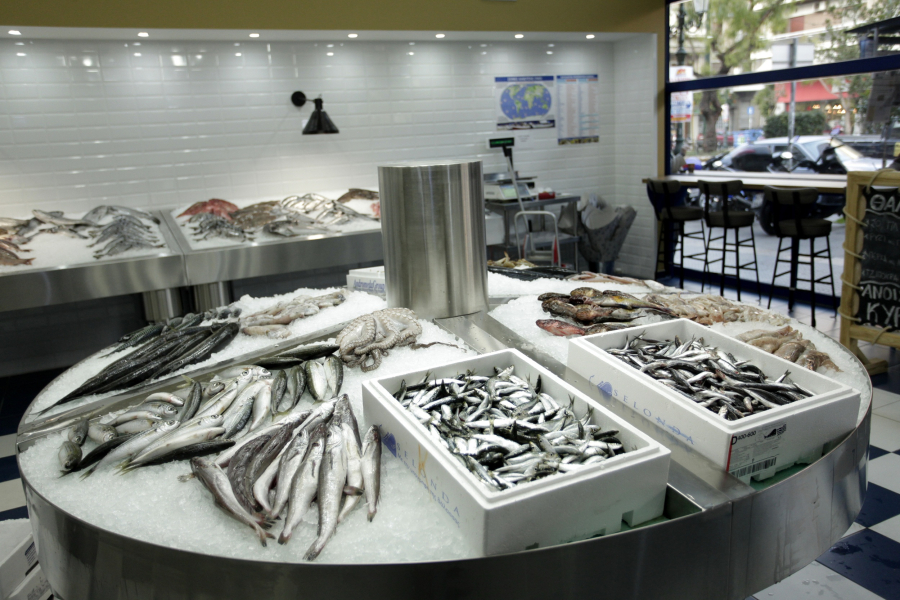
Anchovy represented almost one-quarter of the country’s entire marine catch
Anchovy was the standout species. Greek vessels landed 10,445.1 tons, worth €19.55 million, meaning the small pelagic fish alone represented almost one-quarter of the country’s entire marine catch.
Sardines ranked second by volume at 4,541.6 tons, followed by round sardinella at 2,603.6 tons, shrimp at 2,067.5 tons and hake at 1,949.2 tons. Together, those five species accounted for 51.3% of the total catch.
The picture changed somewhat when measured by value. Anchovy remained first at €19.55 million, followed by hake at €16.88 million and sardines at €14.17 million. Striped red mullet generated €9.30 million and shrimp €8.24 million.
Τhe North Aegean was Greece’s undisputed fishing powerhouse
Geographically, the North Aegean was Greece’s undisputed fishing powerhouse. The region produced 28,452.9 tons worth €101.02 million, accounting for roughly two-thirds of national production.
The South Aegean followed with 9,183.2 tons valued at €43.15 million, while the Central Ionian Sea produced 3,106.7 tons worth €14.96 million.
The figures highlight a defining feature of Greek fishing: scale and value don’t necessarily move together. A few hundred purse seiners and trawlers account for most of the volume, while the much larger coastal fleet generates the biggest share of revenue. And across Greece’s extensive fishing grounds, the humble anchovy remains the industry’s king.