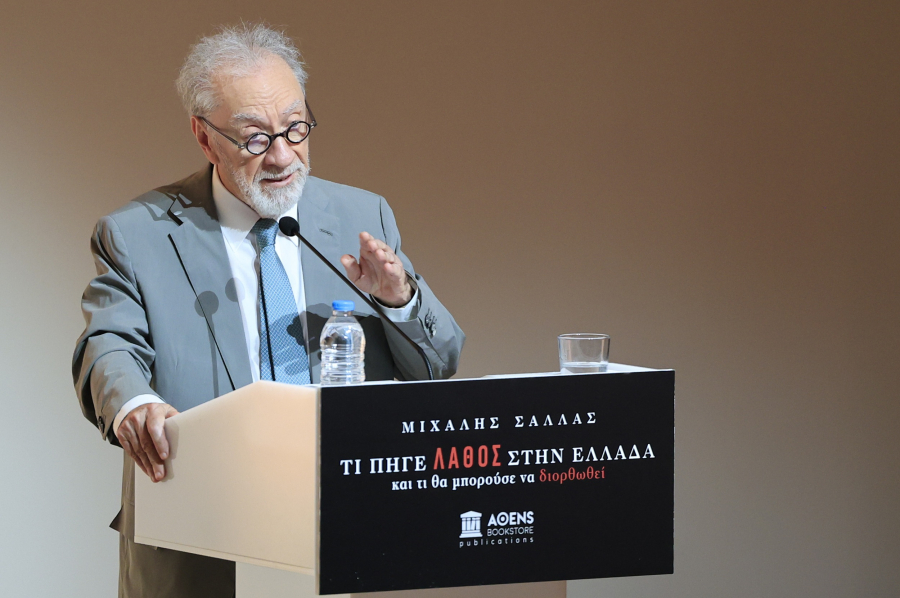

The publication of former Piraeus Bank Chairman Michalis Sallas’s new book, “What Went Wrong in Greece and What Could Be Fixed”, has brought renewed attention to one of the most complex banking cases to emerge as Greece was struggling to recover from its sovereign debt crisis.
At the center of the case was a special supervisory audit carried out by the Bank of Greece in 2017 at Piraeus Bank, one of the country’s four systemic lenders. The audit's findings, which were forwarded to prosecutors later that year, formed the basis of a judicial investigation that lasted nearly three years but ultimately never reached a public criminal trial.
The audit examined an intricate network of financing arrangements involving interconnected companies, loan transfers, refinancing transactions, capital movements, alleged breaches of capital controls, and beneficial ownership structures spanning multiple jurisdictions. Supervisors sought to determine whether the bank had complied with corporate-governance standards, lending procedures, rules governing related-party transactions, and broader regulatory obligations.
One of the transactions examined involved a loan granted in 2009 to SHENT Enterprises Ltd., a Cyprus-based company linked to Mr. Sallas. The company secured a revolving credit facility of up to €50 million from Marfin Egnatia Bank, which later became Marfin Popular Bank and subsequently Cyprus Popular Bank. The loan was secured by 15.87 million shares of Piraeus Bank pledged by Mr. Sallas, SHENT Enterprises and Alkimon Holding Ltd., which the supervisory report identified as a company connected to SHENT.
The transaction took on greater significance following the restructuring of Cyprus's banking sector in 2013. After the bailout and restructuring of Cyprus Popular Bank, its Greek operations—including branches, assets and loan portfolios—were transferred to Piraeus Bank. Among the assets acquired was the SHENT loan, leaving Piraeus managing a multimillion-euro credit exposure involving its own chairman, a circumstance that drew scrutiny from both the Bank of Greece and the European Central Bank's newly established Single Supervisory Mechanism (SSM).
According to the audit, the outstanding balance stood at roughly €44 million. Interest payments during 2013 and 2014 were made either through SHENT's bank account in Cyprus or by bank checks funded through transfers from Mr. Sallas's personal account. The investigation focused on a decision taken on May 18, 2014, when Piraeus Bank's Executive Committee approved the substitution of SHENT Enterprises by Summit Property Ltd., a company incorporated in the British Virgin Islands. Summit assumed all obligations under the loan agreement and became the new borrower. According to the supervisory findings, Summit subsequently transferred approximately €44.3 million to Piraeus Bank through Germany's Berenberg Bank, fully repaying the facility.
For supervisors, however, the critical issue was not the repayment itself but who had financed it and who ultimately controlled Summit Property. Piraeus Bank initially stated that, based on documentation available when the relationship began, the company's beneficial owner was Giorgos Vrachnakis, a Greek seafarer residing in Cuba. The supervisory audit reached a different conclusion, stating that at the time of the repayment Summit's beneficial owners were directly linked to the Libra Group, controlled by the Logothetis family.
The discrepancy between the bank's records and the supervisors' findings became a central focus. Auditors traced successive changes in the ownership of companies to establish who exercised effective control over both the funds and the outstanding liabilities. The investigation also followed the money trail to Berenberg Bank, noting that Summit's account—through which the €44.3 million repayment was executed—had been opened in August 2014 and closed in September 2017, coinciding with the Bank of Greece's special supervisory inspection. Supervisors also examined Baywest Business Ltd., another company they linked to the Libra Group. According to the report, Baywest maintained accounts at the same German bank and shared the same corporate representative as Summit Property, a connection auditors considered relevant in mapping the corporate relationships.
Attention then shifted to another major transaction. On May 19, 2014—just one day after Summit replaced SHENT as borrower—Piraeus Bank approved the sale of 85 non-performing loans with a nominal value of approximately €1.05 billion to Baywest for around €320 million. The portfolio consisted largely of shipping loans secured by vessels, real-estate development loans and syndicated infrastructure financings. The supervisory report also examined the role of LXM Group, which acted as loan broker in the transaction.
According to the auditors, LXM was also connected to the Libra Group and had recommended Baywest as purchaser of the portfolio, raising questions, in the supervisors' view, about the transparency and objectivity of the sale process. Auditors further noted that the shipping-loan segment of the portfolio was sold for approximately €135.7 million, around €56.9 million below the collateral value of the vessels securing those loans.
The timing drew particular scrutiny. As Baywest began acquiring and subsequently disposing of portions of the non-performing loan portfolio, Summit had already assumed and repaid the SHENT loan. Supervisors examined whether the two transactions were connected and sought to trace the movement of funds between them. The report also found that, by the conclusion of the supervisory audit, Baywest had not completed payment of the agreed purchase price. By the end of 2016, approximately €94.3 million of the €320 million consideration had been paid, while Piraeus Bank was still seeking a solution to complete the transaction between April 2016 and June 2017.
Taken together, the loan substitution, changes in beneficial ownership, capital flows and sale of the non-performing loan portfolio became one of the most extensive supervisory investigations conducted into Greece's banking sector.
The case was subsequently referred to prosecutors and remained under judicial investigation for several years. However, amendments to Greece's Criminal Code in 2019 concerning felony breach of trust involving bank executives meant the case ultimately did not proceed to a public criminal trial.
Despite the legal outcome, several questions identified by supervisors remain unresolved, including the source of the funds used to repay the loan after Summit replaced SHENT, the financial arrangements between the two companies, and the ultimate disposition of the collateral, including the luxury yacht Condor A.
Nearly a decade later, the case continues to serve as a touchstone in discussions about corporate governance, large corporate lending and banking supervision in Greece. While the legal proceedings have effectively concluded, the supervisory findings continue to attract public interest because several of the key questions raised during the investigation remain unanswered.