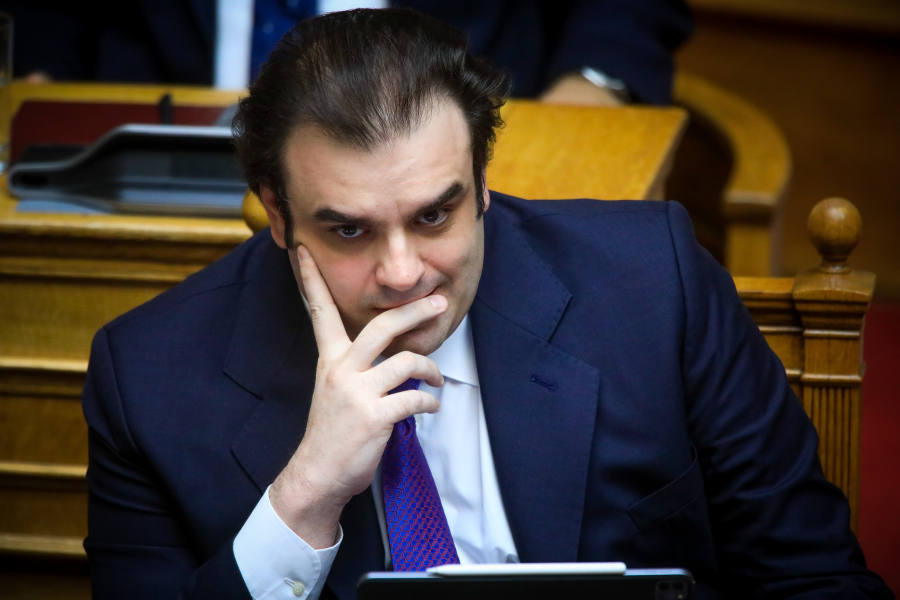

Greek Finance Minister Kyriakos Pierrakakis said the country’s primary budget surplus is likely to come in above expectations this year and pledged that the government stands ready to deploy additional support measures if mounting geopolitical tensions trigger a deeper energy shock.
Speaking from the headquarters of the International Monetary Fund in Washington, Pierrakakis downplayed the IMF’s revised forecast for Greek economic growth, which cut the country’s outlook to 1.8%, and said Athens would not alter its economic strategy in response.
The minister said the downgrade reflected broader international pressures rather than domestic weakness, pointing to the escalating crisis in the Strait of Hormuz, a critical artery for global energy shipments, as a source of heightened uncertainty for economies across Europe and beyond.
“The government is prepared for all scenarios,” Pierrakakis said, warning that a prolonged disruption in the Strait could trigger an energy crisis more severe than the oil shocks of the 1970s if the region fails to return quickly to normal operations.
His remarks come as governments across Europe brace for the economic fallout of rising energy prices and renewed inflationary pressure tied to instability in the Middle East.
Pierrakakis acknowledged that inflation remains a challenge for Greek households but said the government is better positioned to respond than during the 2022 energy crisis, citing experience gained from prior support programs including fuel subsidies and targeted aid for businesses and farmers.
He said Greece’s stronger-than-expected fiscal performance would provide some room for maneuver, though he cautioned that any new spending measures would need to comply with the European Union’s revised fiscal rules and be coordinated with the European Commission.
“Any additional resources created by stronger economic performance will be returned to society,” he said.
Pierrakakis argued that Greece is now more resilient to external shocks than in previous crises, citing above-average economic growth, declining public debt, and stronger structural fundamentals driven by higher investment, improved exports, and efforts to curb tax evasion.
Still, he said the scale of any intervention would depend on how long the current disruption lasts, noting that a short-lived shock would require a different response from a crisis stretching over several months.
Even if shipping routes through the Strait of Hormuz reopen quickly, inflationary pressures may persist because damage to Middle Eastern energy infrastructure could take time to repair, he said.
Pierrakakis said Greece remains in close contact with European officials over potential coordinated responses and emphasized that any measures introduced would be temporary and targeted.
“A fiscal crisis must not emerge out of an energy crisis,” he said.