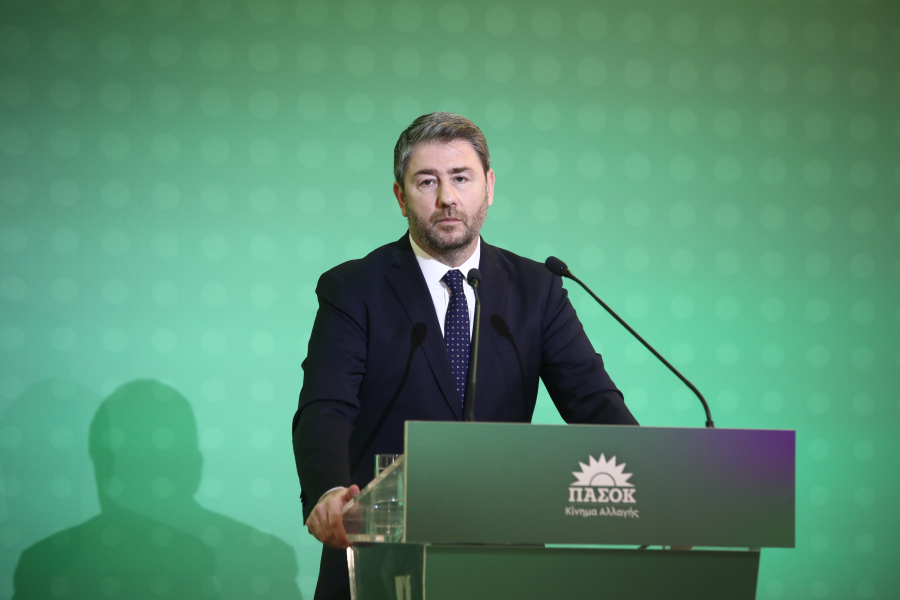

As revealed on Tuesday by in.gr, one of Greece’s leading news websites, Greece’s independent authority responsible for safeguarding the secrecy of communications appears to be deflecting responsibility in its responses to questions submitted by the European Court of Human Rights (ECtHR) in connection with the surveillance case involving Nikos Androulakis, leader of the centre-left PASOK–Movement for Change party.
The questions were forwarded to the Authority for the Protection of the Secrecy of Communications (ADAE) by the Legal Council of the State, following an application lodged by Androulakis over the failure of Greece’s National Intelligence Service (EYP) to comply with a ruling of the country’s highest administrative court. That ruling required the authorities to formally inform him of the reasons he had been placed under surveillance.
When the ECtHR decided to give priority treatment to Androulakis’ application, it addressed two preliminary questions to the Greek government. According to information obtained by in, the first concerns Androulakis’ claim that he has been unable to learn the reasons for his surveillance because the relevant intelligence files were destroyed by the EYP, raising issues under Article 8 of the European Convention on Human Rights, which protects the right to respect for private life. The second concerns the alleged failure to execute a 2024 ruling of the Council of State, after the intelligence service refused to disclose the justification for the surveillance, a matter linked to Article 6 of the Convention, which guarantees the right to a fair trial.
In its ruling No. 465/2024, Greece’s Council of State held that when communications secrecy is lifted for reasons of national security and a person is monitored by the authorities, the individual must be informed, once the surveillance ends, of the reasons for the measure in order to have access to effective judicial protection.
Despite this, when the intelligence service was asked in May 2024 to brief the communications watchdog on the Androulakis case, its director, Themistoklis Demiris, cited a prosecutorial order referring only to “national security reasons” and refused to disclose the full justification for the surveillance. Androulakis had been monitored between September and December 2021, at a time when he was a Member of the European Parliament and later became leader of the main opposition.
Seeking to respond to the ECtHR’s questions, the Legal Council of the State requested the views of the communications authority and any relevant material to defend what it described as the interests of the Greek state. In its reply, the authority argued that Androulakis had failed to exhaust domestic legal remedies, claiming that he had not filed a specific application before the Council of State alleging improper execution of its 2024 ruling.
According to information from in, the authority stated that, as a result, the applicant had not made full use of the legal avenues available under Greek law before turning to the Strasbourg court. Legal sources, however, told in that this argument is expected to be rejected during the examination of the case.
The most striking element of the authority’s response, however, is its apparent attempt to distance itself from responsibility for informing individuals who have been subjected to surveillance. Citing a passage from the Council of State ruling, the authority maintains that it is not the body that received access to retained telecommunications data from service providers and therefore cannot itself inform Androulakis. Instead, it effectively shifts that responsibility to the intelligence service.
This position creates a paradox: the very authority tasked with safeguarding the secrecy of communications claims it is not competent to inform a citizen whose communications were placed under surveillance, even in a case that has become emblematic of Greece’s wiretapping scandal.
The authority also denies that Androulakis was prevented from accessing the courts or from legally challenging the surveillance measures. At the same time, the Council of State ruling explicitly states that the head of the authority and authorised members have full access to the prosecutorial orders authorising the lifting of communications secrecy.
During the preliminary examination of the application, the Vice-President of the European Court of Human Rights indicated that the Androulakis case could be classified as a “leading” or “pilot” case, meaning that it could shape future European case law on surveillance and transparency. This assessment underscores the broader legal significance of the case beyond Greece.
The Legal Council of the State was required to submit its written observations and account of the facts to the Strasbourg court by 16 February. Further developments in the case are expected after mid-March.