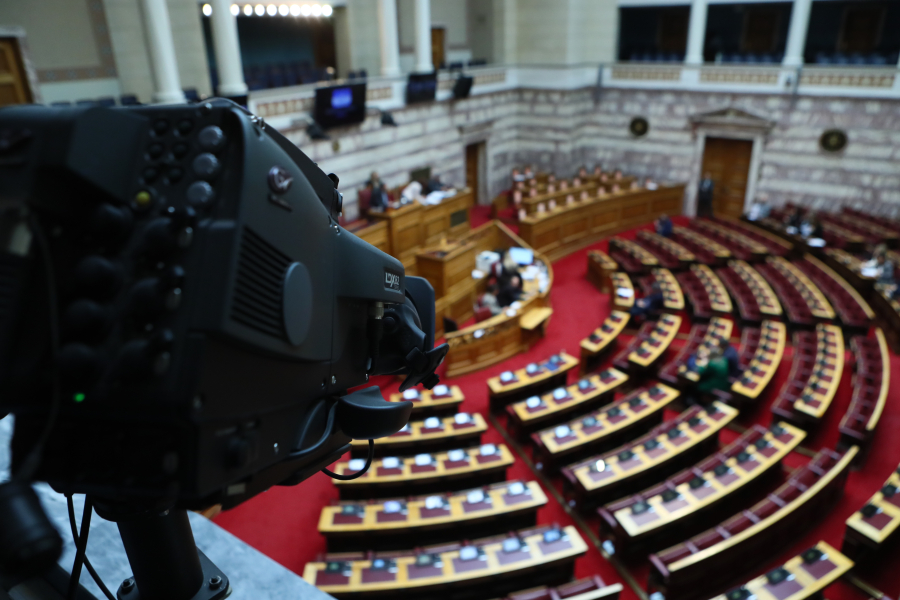

Parliament on Wednesday begins debating a new labour bill aimed at strengthening collective bargaining in Greece, a move the government describes as a landmark reform in industrial relations.
The draft law, titled “National Social Agreement for the Strengthening of Collective Labour Agreements,” transposes into legislation a historic pact signed two months ago between the Greek government and the country’s main social partners. These include trade unions and employer organisations representing workers, industry, small and medium-sized enterprises, commerce, tourism and regional business.
The bill is notable not only for its content but also for the way it was prepared. It was jointly shaped by the Ministry of Labour and Social Security and all national social partners, reflecting a rare consensus after years of fragmented labour relations. The text consists of 16 articles and was subject to a two-week public consultation process.
At the core of the reform is an effort to make it easier for collective labour agreements to be extended across entire sectors. Under existing rules, such agreements can be declared universally binding only if they cover more than half of the workforce in a given sector or profession. The new legislation lowers this threshold to 40 percent. It also introduces a further innovation: when a sectoral agreement is co-signed by national social partners, the quantitative coverage requirement will no longer apply at all, facilitating broader application.
The bill also clarifies how the scope of sectoral agreements will be defined, using business activity classifications and other sector-specific criteria. To support this process, operational registries of trade unions and employer organisations will be streamlined, with registration requirements reduced to essential information only. Importantly, failure to register will no longer affect rights stemming from trade union activity, and registration will be required solely for extending agreements or seeking mediation and arbitration.
Another central element concerns the protection of workers after collective agreements expire. All employment terms set out in an agreement will remain in force following its expiration, alongside a three-month extension period. After that, the full set of terms will continue to apply until a new collective or individual contract is signed. In doing so, the bill abolishes a provision introduced during the financial crisis in 2012 that limited this post-expiration protection, restoring the pre-crisis framework of full continuity. Newly hired workers during the extension period will also be covered.
Finally, the legislation seeks to accelerate the resolution of labour disputes. A new pre-screening mechanism will assess unilateral requests for mediation and arbitration, overseen by a three-member committee composed of a labour law professor, an economics professor and a retired senior judge. At the same time, a second level of arbitration will be abolished to speed up proceedings, while preserving the right to challenge arbitration rulings in court.