
A new nationwide opinion poll conducted by Opinion Poll for Action24 shows New Democracy maintaining a clear lead in Greek politics, at a moment when speculation about new political movements linked to prominent figures is adding fresh uncertainty to the country’s political scene.
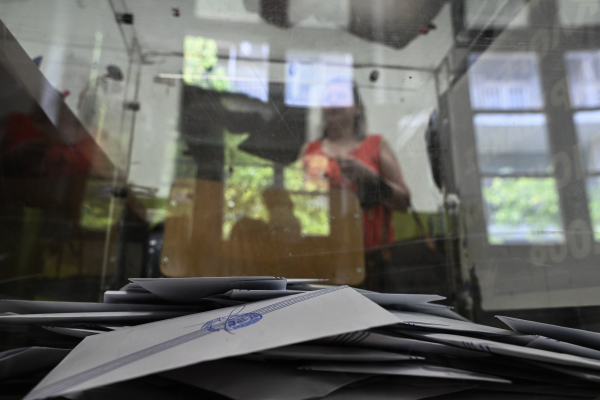
According to the survey, which was presented on Monday, New Democracy records 24.4% in voting intention, confirming its dominant position. The centre-left PASOK comes a distant second with 10.8%. In third place, a notable shift is observed as Course of Freedom, led by former parliamentary speaker Zoe Konstantopoulou, reaches 8.5%, slightly ahead of the nationalist Greek Solution at 8.1%. The Communist Party of Greece follows with 6.6%, while SYRIZA, the former governing party, falls to 3.4%, tied with the smaller Voice of Reason party.
Several parties remain below Greece’s 3% parliamentary threshold, including MeRA25, Niki, the Democracy Movement and the New Left. One of the most striking findings of the poll is the very high share of undecided voters, which stands at 19.1%, underscoring the fluidity of the current political environment.
When respondents are asked to estimate final vote shares, New Democracy’s lead widens to 30.2%, suggesting it would benefit most from undecided voters. PASOK follows with 13.4%, while Course of Freedom and Greek Solution are both projected in double digits, at 10.4% and 10.1% respectively. The Communist Party is estimated at 8.2%, while SYRIZA and Voice of Reason remain marginally above 4%.
The poll also explores leadership perceptions. Prime Minister Kyriakos Mitsotakis is considered the most suitable candidate for prime minister by 29% of respondents. However, almost the same proportion, 28.7%, choose “no one,” reflecting widespread dissatisfaction with the political class. Zoe Konstantopoulou ranks next among named politicians, followed by Kyriakos Velopoulos, leader of Greek Solution, and PASOK leader Nikos Androulakis.
Considerable attention is given to hypothetical new political parties. Asked about the possibility of voting for a party associated with Maria Karystianou, a figure who has gained public prominence outside traditional party structures, just over half of respondents say they would not consider it. Still, nearly three in ten describe such a vote as fairly or very likely, suggesting a potential opening for new political formations. Most respondents believe such a party would draw support across the ideological spectrum rather than from a single political camp.
By contrast, the prospect of a new party led by former prime minister Alexis Tsipras is met with greater scepticism. More than two-thirds say they would not vote for it, while fewer than one in five express a positive inclination. An even more negative response is recorded for a hypothetical party led by another former prime minister, Antonis Samaras, with nearly three-quarters of respondents rejecting the idea outright.
Beyond party politics, the survey highlights strong public anxiety over international developments. More than 80% of respondents say they are very concerned about recent geopolitical tensions, and a similar share believe these challenges make political stability and strong leadership essential for Greece.
Domestic economic issues remain equally pressing. A majority of respondents judge the opposition’s handling of farmers’ protests as misguided, although many also believe the government has failed to meet a substantial portion of farmers’ demands. Opinions are divided over the tactic of blocking major highways during protests, with a slim majority opposing it.
Looking ahead, economic pessimism dominates. Nearly half of respondents expect conditions to worsen by 2026, while only a small minority express optimism. Rising prices and inflation are identified as the country’s most serious problem, far ahead of economic growth, justice and corruption, or the state of the healthcare system, painting a picture of a society under sustained economic pressure despite political stability at the top.