

The Greek government's decision to launch a parliamentary inquiry into the OPEKEPE scandal—a case involving alleged fraud in agricultural subsidies—has ignited fierce criticism, not least because the investigation is set to stretch all the way back to 1998. Critics argue this is a deliberate attempt to deflect attention from recent revelations implicating members of the current administration.
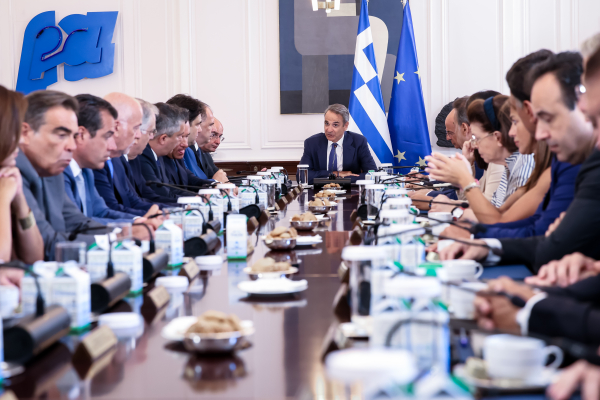
OPEKEPE, the agency responsible for managing EU agricultural funds in Greece, is at the center of a high-profile corruption probe initiated by the European Public Prosecutor’s Office. According to case files, the fraud involves fake subsidy claims and organized misuse of EU funds, with the alleged wrongdoing taking place under the watch of the current government, led by Prime Minister Kyriakos Mitsotakis.
Rather than addressing the core findings of the European investigation, the government has opted for a sweeping parliamentary inquiry that will examine the agency's operations from its founding during the premiership of Costas Simitis in 1998. This move has been criticized as an effort to blur the lines of accountability by burying current misconduct in decades of bureaucratic history.
Announcing the inquiry, government spokesperson Pavlos Marinakis justified the decision by claiming the problem of false agricultural subsidies is a long-standing issue. He said Greece has lost €2.7 billion over 30 years due to such fraud, and warned against viewing it as a problem of any single government. But this explanation has failed to convince many observers, who point out that the current scandal concerns specific criminal allegations and named individuals serving in the Mitsotakis administration.
Adding to the controversy is the apparent inconsistency in how different cases are handled. In previous scandals involving former ministers—such as Christos Triantopoulos and Kostas Karamanlis—the government permitted pretrial parliamentary procedures. Yet in the OPEKEPE case, no such process has been initiated, even though key figures like Agriculture Minister Makis Voridis and former Deputy Minister Lefteris Avgenakis are reportedly implicated.
The explanation given by Marinakis is that the government is taking a measured approach, distinguishing between political and criminal responsibility. He emphasized that ministers referred for judicial examination are not presumed guilty. Still, this stance leaves unanswered why some cases are forwarded to legal authorities and others are not. The decision appears even more arbitrary when considering that the OPEKEPE investigation was not instigated by political opponents, but by European prosecutors.
Observers see this as part of a broader pattern in which the government applies selective standards of accountability. By launching an all-encompassing inquiry stretching back 27 years, critics say the government is engaging in what amounts to institutional misdirection—shifting the focus away from today’s problems by diluting them in a historical review of long-past irregularities.
Analysts suggest the government has three motives for this approach. First, to shield key figures like Voridis, who is said to have warned that he would leave the ruling party if thrown under the bus. His departure could destabilize the fragile balance between New Democracy and the far-right, giving extreme elements a new figurehead. Second, by flooding the public with decades of allegations, both real and speculative, the government encourages a sense of confusion and false equivalency. If corruption is portrayed as universal and timeless, it becomes harder for citizens to hold anyone specifically responsible. Finally, the tactic may be designed to foster public cynicism and disengagement.
When corruption is seen as endemic and punishment as unlikely, political apathy becomes the default—a dynamic that serves the ruling elite in the short term, even as it corrodes democratic accountability in the long run.
At its core, the government's handling of the OPEKEPE affair reveals a strategy not of transparency, but of control. By framing the inquiry as a deep dive into systemic issues, it sidesteps the urgent question of individual responsibility. And in doing so, it risks turning a moment of reckoning into yet another chapter of institutional evasion.