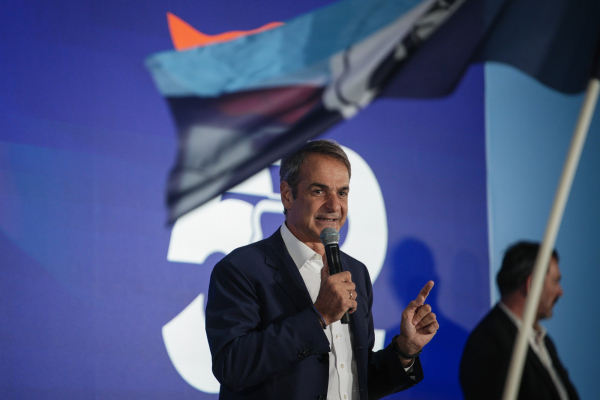


National Bank of Greece Chief Executive Pavlos Mylonas had a blunt way of explaining one of the biggest challenges facing banks rushing into artificial intelligence. “Garbage in, garbage out,” he said—though his Greek version was considerably more colorful. The point: Even the most sophisticated AI is only as useful as the data feeding it.
Speaking at National Bank of Greece’s “Future Banking Today” technology event in Athens, Mylonas laid out how one of Greece’s largest lenders is rebuilding its technology infrastructure for a banking world increasingly dominated by artificial intelligence, digital distribution and, eventually, transactions conducted by autonomous AI agents.
For Mylonas, the bigger risk is waiting. Technology overhauls are expensive, take years and can be tempting for executives to leave to their successors, he said. Banks that take that approach will ultimately pay a steep price.
ΔΙΑΒΑΣΤΕ ΕΠΙΣΗΣ



National Bank has instead spent years replacing technology while keeping the lender running—akin to rebuilding an aircraft in flight. One measure of the overhaul is the number of information-technology systems: The bank has reduced them to about 50 from roughly 500 over five years, Mylonas said.
Today, 98% of transactions take place outside branches, while the technology transformation has generated more than €200 million, equivalent to about $230 million, in annual operating benefits, according to the bank.
The next battleground is moving banking closer to where customers actually spend money.
“The future is embedded banking,” Mylonas said. Rather than visiting a bank to arrange a consumer loan, a customer buying a product could obtain financing at the point of sale, potentially while standing in the checkout line. Traditional branches would remain relevant for mortgages and more complex services, but consumer credit increasingly could become part of the purchasing experience itself.
The bank is already looking beyond that model.
Stratos Molyviatis, National Bank’s general manager for group operations, described a future in which customers’ AI agents communicate and transact directly with the bank’s own agents. Corporate customers are likely to adopt such “agent-to-agent” banking first, with personal AI assistants potentially following.
The concept could allow a company’s AI system to interact directly with the bank to initiate batches of transactions or access financing, insurance and investment services.
National Bank already operates about 150 open-banking application programming interfaces, or APIs, connecting financial services with e-commerce platforms, enterprise-resource-planning software and companies’ back-end systems. The next step is to develop AI-ready interfaces capable of processing agent-driven transactions with very low latency.
That shift brings an obvious complication: security.
National Bank expects agent-to-agent banking to require “zero trust” architecture, meaning neither side automatically assumes that a user, device or AI agent is authorized. Controls would need to prevent both data theft and, potentially more importantly, transactions that an AI system wasn't authorized to execute.
And the bank isn’t treating autonomous transactions as a distant 2030 scenario. Molyviatis said initial work on agentic transactions, focused primarily on business banking, is expected to begin within the next three months.