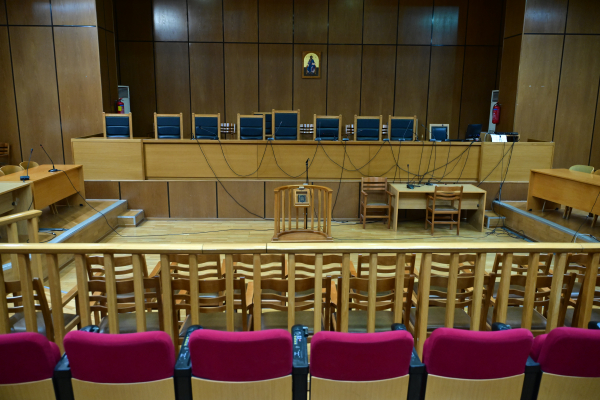
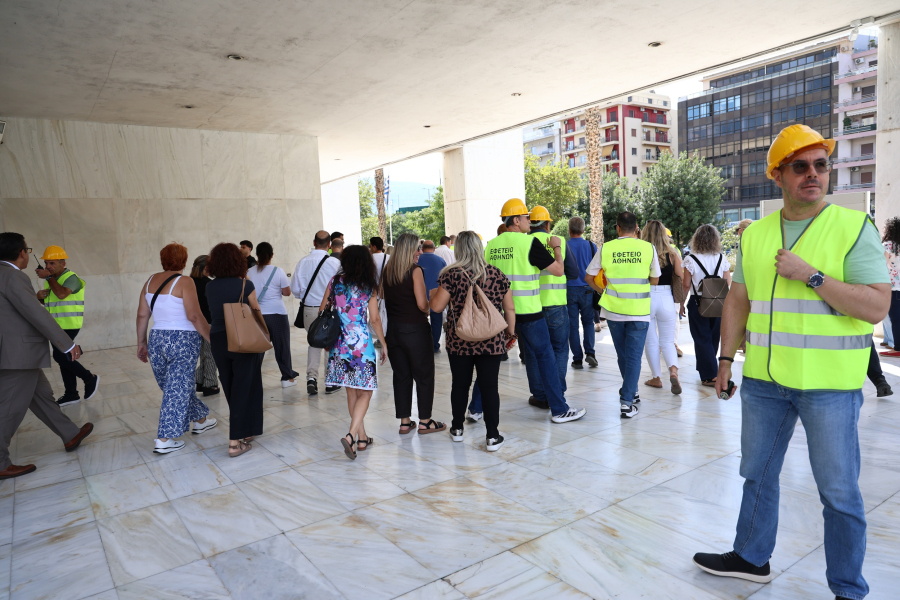

One of Greece’s busiest courthouses emptied thousands of judges, lawyers, employees and members of the public in just over nine minutes on Monday, in what officials described as the country’s first full-scale evacuation exercise conducted in a working judicial building.
The Athens Court of Appeals completed the evacuation in nine minutes and four seconds, a closely watched test of emergency preparedness at a complex that can accommodate about 5,000 people on a typical working day.Unlike exercises conducted in largely empty public buildings, Monday’s drill took place at about 11:45 a.m., while the court was operating normally. Judges were hearing cases, lawyers and prosecutors were at work, clerks were at their desks and members of the public were moving through the building when the alarm sounded.
Participation was mandatory.
The exercise marked an unusual logistical test for Greece’s judicial system, where large courthouses routinely bring together thousands of people who may have little familiarity with emergency procedures. The Athens complex, on Loukareos Street near the center of the capital, is among the country’s most heavily used judicial facilities.
The evacuation was organized by the court’s administration in cooperation with its fire-safety team and Greece’s Judicial Police, a relatively new law-enforcement body responsible for security and other functions connected with the country’s courts.
Court employees played a central role in directing people out of the building and toward the designated assembly area outside the nearby Supreme Court of Greece, known locally as the Areios Pagos.
The exercise was overseen by the three-member administration of the Athens Court of Appeals, led by senior appellate judge Sofia Lignou, alongside appellate court presidents Dimitris Kontopoulos and Kostas Sargiotis.
Supreme Court President Panagiotis Lymberopoulos and Pelops Laskos, secretary-general of Greece’s Justice Ministry, were also present.
For administrators, the drill was about more than setting a respectable time. It was intended to determine whether procedures that look workable on paper can function when thousands of people have to leave a large public building simultaneously.
Fire Service officer Alexandros Mesimertzis, who has helped train judges and court employees in fire-safety procedures, told those gathered after the exercise that completing the first evacuation in nine minutes and four seconds represented a successful start.
The training that preceded the drill was organized through seminars initiated by the court’s administration. Such preparation is particularly important in a courthouse, where the population inside changes constantly and many visitors have no prior knowledge of evacuation routes or assembly points.
Officials now want to turn the exercise into a routine rather than a one-off event. The court administration’s goal is to hold two fire-safety and evacuation drills each year, using each exercise to identify weaknesses and improve the response time.
Mesimertzis said the next drill should aim for an even better performance.
The initiative reflects a broader challenge for public institutions: emergency plans are only as effective as the ability of employees and visitors to follow them under pressure. In a courthouse, the problem is compounded by crowded corridors, multiple courtrooms and a daily flow of defendants, witnesses, lawyers and citizens unfamiliar with the building.
For the Athens Court of Appeals, Monday’s first test produced a simple benchmark: 9 minutes, 4 seconds.