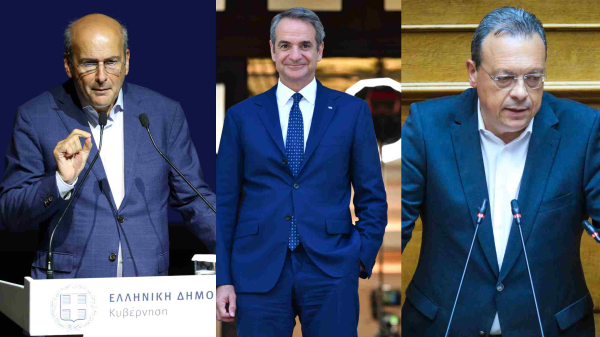
Foreign Minister George Gerapetritis said in an interview with To Vima that «the Greece of passive diplomatic inaction is irrevocably a thing of the past» adding that Athens wants peace with Ankara, but “from a position of strength.”
The timing is notable. Days earlier, Samaras had again accused the Mitsotakis government of appeasing Turkey, arguing that its pursuit of “friendships” and Ankara’s international rehabilitation was facilitating new faits accomplis at Greece’s expense.
His intervention followed Turkey’s announcement of marine parks in areas contested by Athens. Samaras described the move as “another act of international piracy” and warned that Ankara could next seek to formalize its “Blue Homeland” doctrine, which asserts expansive Turkish maritime interests.
ΔΙΑΒΑΣΤΕ ΕΠΙΣΗΣ



«What exactly are we doing? What is our strategy?» Samaras asked, warning that Turkey was seeking to restrict Greece’s ability to exercise its sovereign rights in the Aegean.
Gerapetritis’s response now sounds considerably closer to Samaras’s warnings than to the conciliatory language associated with Greek-Turkish rapprochement.
The foreign minister called Turkey’s marine parks “illegal,” saying they produce no legal consequences where they extend beyond Turkish territorial waters into areas where Greece claims continental-shelf rights. “Any attempt to infringe upon our sovereign rights will be confronted by every appropriate means,” he said, adding that Greece is “absolutely prepared for every scenario.”
Most significantly, Gerapetritis reaffirmed Greece’s right to extend its territorial waters to 12 nautical miles, describing it as an inalienable right that Athens can exercise unilaterally “at a time and in a manner that will be chosen by the Greek state.”
Turkey has long opposed such an extension in the Aegean, with its parliament in 1995 authorizing measures, including military action, should Greece proceed—a position Athens regards as a threat of war.
Gerapetritis maintains that de-escalation nevertheless benefited Greece by providing time to strengthen its economy, armed forces and international alliances. He cited Rafale fighters, upgraded F-16s, Belharra frigates and forthcoming F-35s as evidence of Greece’s stronger strategic position. The government, then, isn’t abandoning dialogue. It is recasting it as diplomacy backed by deterrence.
But the political irony is increasingly difficult to overlook. Samaras has long warned that engagement without clear demonstrations of resolve could encourage Turkish pressure. The Mitsotakis government now emphasizes precisely the principles he demanded: strength, preparedness, sovereign initiative and firm limits to accommodation.
Athens still insists its “calm waters” strategy worked. Its new rhetoric, however, suggests that when it comes to Turkey, the Mitsotakis government has belatedly moved onto Samaras’s ground.