
Both come with significant unanswered questions.
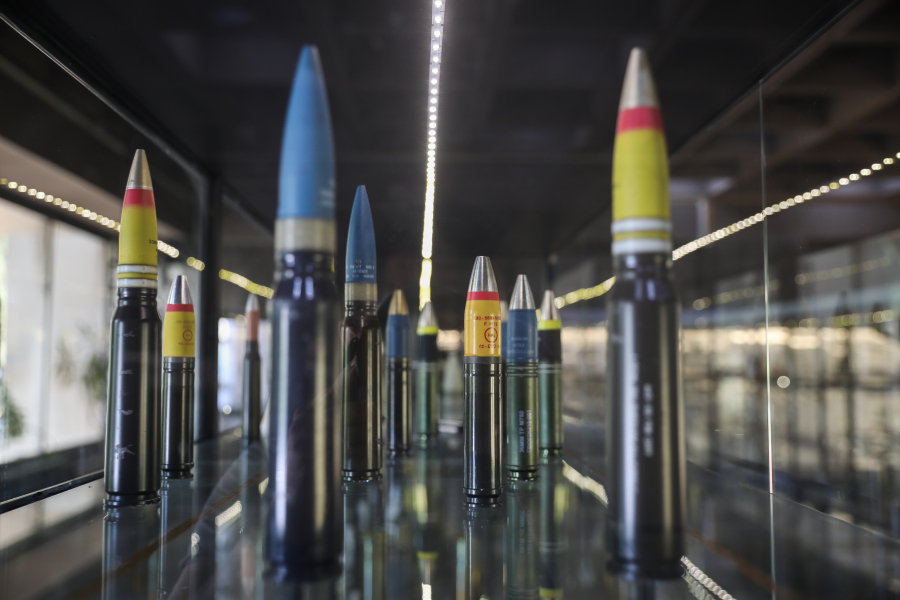
The strategic plan, prepared by EY-Parthenon and approved by the company’s board on July 9, seeks to revive Hellenic Defence Systems, known in Greece as EAS, largely through joint ventures with domestic and foreign industrial groups.
The premise is that strategic partners would bring capital, technology, access to export markets and, crucially, new orders. EAS would use those partnerships to increase production and modernize its factories at a time when European governments are seeking to expand domestic defense-manufacturing capacity.
The financial projections are ambitious. Under a scenario broadly reflecting the company’s current trajectory, cumulative pretax profit over the next decade is projected at €190 million. The plan’s base case raises that figure to €272.6 million, while an accelerated-growth scenario forecasts €321.6 million.
But the central question is what business will generate those earnings.
The strategy calls for at least six joint ventures to be operational between 2026 and 2028. So far, one has been established. Hellenic Ammunition is 51% owned by EAS, with the remaining 49% held through Czech defense group Czechoslovak Group and its MSM unit. The business plan describes the venture’s success as critical to strengthening EAS’s production base.
A second partnership is under discussion with India’s Kalyani Group, potentially using the same 51%-49% ownership structure and focusing on EAS facilities in Aigio, in the northern Peloponnese.
Important details, however, remain unclear. The proposed venture’s precise activities haven’t been defined publicly, nor has the amount Kalyani might invest, the production lines it could operate or the orders it would bring.
The uncertainty is even greater for the four additional joint ventures required to reach the six-partnership target by 2028. The plan doesn’t identify the partners, the sectors in which they would operate or the contracts expected to support them.
Those questions are particularly important because the strategy depends on substantial financing. It envisages capital increases totaling €88.8 million through 2029, including €50.7 million in 2026. Investment requirements are estimated at roughly €100 million to €105 million. The plan also assumes EAS will receive €33 million in 2027 from the expropriation of company-owned land near Athens.
The challenge is turning financial projections into actual production. Joint ventures alone won’t be enough. EAS will need investors willing to commit capital and, above all, firm defense orders capable of supporting forecasts of more than €300 million in cumulative pretax profit.
At the same time, the company faces a separate and potentially costly problem at its facilities in Lavrio, an industrial town southeast of Athens.
A preliminary assessment of environmental contamination puts the potential remediation bill at between €22.55 million and €29.15 million, excluding value-added tax.
The estimate, prepared by an institute affiliated with the European Public Law Organization, is explicitly preliminary. The full extent and depth of the contamination haven’t yet been determined, not all samples have been analyzed and the final cleanup methods haven’t been selected.
Still, early findings are troubling.
Investigators conducted 65 soil, subsoil and groundwater sampling operations between January and May. In one contamination hotspot, average TNT concentrations were estimated at about 2.1% by weight, with one underground layer reaching 14.3%.
About 3,000 metric tons of contaminated soil may need to be excavated and removed, at an estimated cost of €5 million to €7 million once treatment and site restoration are included.
The biggest potential liability, however, involves 10 sludge-settlement tanks believed to contain roughly 50 metric tons of solidified explosive waste. Sampling in five tanks suggests TNT concentrations of 20% to 25% in upper layers, with deeper material potentially exceeding 30%.
Neutralizing and removing the sludge, dismantling the tanks and transporting the material could cost €15 million to €18 million.
The findings leave EAS confronting two challenges at once: proving that its proposed partnerships can generate the orders needed to revive the company, while addressing an environmental and potentially explosive legacy problem whose final cost—and urgency—has yet to be fully established.