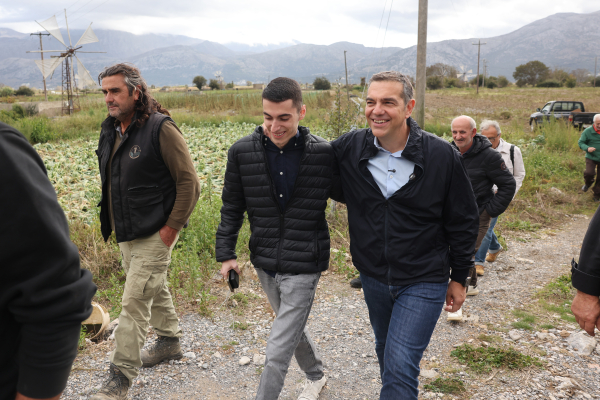
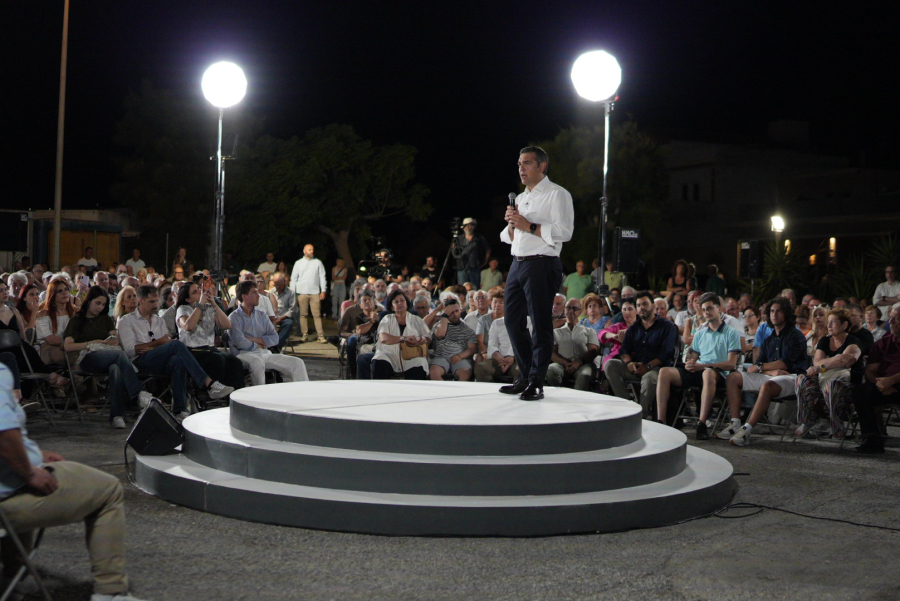
Speaking Thursday during his first online discussion with members of the group, known by its Greek acronym ELAS, Tsipras presented the initiative as an attempt to reorganize Greece’s progressive political space at a time when the center-left and left remain divided and Prime Minister Kyriakos Mitsotakis’s conservative New Democracy dominates national politics.
“The Greek Left Alliance was not created to become one more political force in an already troubled political landscape,” Tsipras said. “It was created to become the political force capable of generating the momentum needed to overturn the current balance of power.”
Tsipras, who served as prime minister from 2015 to 2019 and previously led the left-wing Syriza party, argued that simply bringing together Greece’s existing opposition parties would no longer be enough.
Borrowing from a well-known Greek political phrase, he described the new movement as “not the product of chance, but the mature child of necessity.”
Perhaps two years ago, he said, an effort to bring existing progressive parties together might have been sufficient. But he argued that Greece’s political landscape has since changed.
“Gluing broken fragments back together, adding decline to decline, cannot create momentum,” he said. “It will only produce more decline.”
Tsipras’s remarks amounted to a rejection of efforts to rebuild the Greek left through parliamentary defections or negotiations among established party leaderships. He said the new movement wouldn’t seek to acquire an immediate presence in Parliament by recruiting lawmakers elected under the banner of other parties.
“We are not bargaining,” he said. “We do not want to gain parliamentary representation through MPs who were elected with other political parties.”
Those lawmakers, he added, have every right to remain in their existing parties but wouldn’t simultaneously serve as active members of his new organization.
Tsipras also said there would be no positions reserved in advance for prominent politicians seeking to join the movement, signaling an effort to distance the initiative from the leadership deals and factional bargaining that have often accompanied attempts to reorganize Greece’s opposition.
The comments are particularly significant because of Tsipras’s history with Syriza, the party he transformed from a small coalition of the radical left into a governing force during Greece’s sovereign-debt crisis. Syriza won power in 2015 on an anti-austerity platform but later implemented a new bailout agreement with Greece’s international creditors. The party lost office to New Democracy in 2019, and Tsipras stepped down as its leader after another electoral defeat in 2023.
Asked why he hadn’t pursued a new alliance through Syriza and other existing progressive parties, Tsipras said he had deliberately chosen “the difficult road” rather than building a new project around sitting lawmakers, established political funding and existing party structures.
He insisted, however, that the movement wasn’t excluding people on the basis of their previous political affiliations.
“From the first moment, we addressed—and continue to address—every progressive and democratic citizen, wherever they may have been politically in the past and wherever they are today,” he said.
Tsipras also used the discussion to defend the group’s emerging economic program against government criticism that its proposals are financially unrealistic.
He accused the Mitsotakis government of portraying socially targeted economic policies as unaffordable while accepting policies that, in his view, benefit wealthy taxpayers and powerful business interests.
According to Tsipras, the movement’s economic platform will rest on three principles: stronger social protection, greater tax fairness and fiscal stability.
He said the goal would be to shift more of the economic burden away from lower- and middle-income households and toward wealthier Greeks, while maintaining control of the public finances—a politically important qualification in a country whose debt crisis and years of austerity continue to shape economic debate.
Tsipras also sought to explain what he has described as the movement’s “hybrid” organizational model.
Members, he said, would participate through online organizations where they could debate policy and help shape political positions rather than simply receive instructions from party leaders.
The model is intended to move away from the traditional hierarchical party structure, he said, in which decisions are made at the top while grassroots members meet locally mainly to be informed of the leadership’s political line.
His comments pointed to a broader attempt to build an organization that combines digital political participation with conventional party activity—a potentially significant experiment in Greece, where established parties have traditionally relied on centralized leadership structures and local organizations.
Tsipras also directed criticism at parts of the radical left that, in his view, treat participation in government as an ideological compromise.
“I believe in the power of politics because it has the ability to make people’s lives better,” he said.
He criticized those on the left who, he said, prefer permanent opposition to assuming the risks of governing.
“How can you improve conditions for workers, for the poor and for people facing social exclusion if you are unwilling to take responsibility?” he said.
Governing inevitably involves mistakes and political costs, Tsipras acknowledged, drawing implicitly on his own experience in office during one of the most turbulent periods in Greece’s recent history.
“The path toward social justice and a better world is not a straight line,” he said. “There are climbs and descents. It is not easy.”
The challenge for politicians of the left, he added, was to retain their political identity and remain connected to the people they seek to represent even when confronted with the compromises of government.
Tsipras also outlined some of the movement’s priorities for Greece’s strained public-health system.
He said a future government based on the group’s program would seek substantial pay increases for nurses and doctors, while acknowledging that Greece’s fiscal position would limit the scale of those increases.
The movement has calculated that average increases could exceed €500 for healthcare workers, he said, though he added that the exact proposal would be presented at the Thessaloniki International Fair, the annual September event at which Greek political leaders traditionally lay out their economic programs.
Tsipras also called for additional hiring to address staff shortages and for greater investment in primary healthcare, arguing that a stronger community-care network would reduce pressure on Greece’s hospitals.
The online event offered an early glimpse of how Tsipras intends to position his political comeback. Rather than presenting his project as another coalition of Greece’s existing left-wing parties, he is seeking to cast it as a new vehicle capable of attracting voters across the broader progressive camp while avoiding the organizational baggage of Syriza and its rivals.
Whether that strategy can alter Greece’s political balance will depend in large part on whether Tsipras can translate his continued personal visibility into a durable political organization—and whether voters who once propelled him to power are prepared to give him another opportunity to reshape the country’s left.