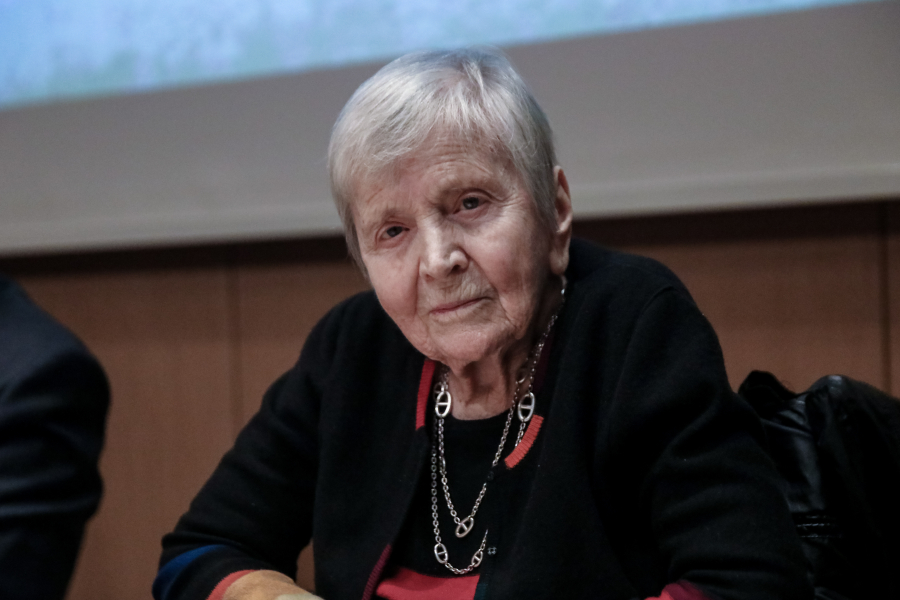

Eleni Glykatzi-Arveler, one of Europe’s most eminent historians of Byzantium and the first woman to serve as rector of the Sorbonne, has died at an advanced age.
A towering figure in Byzantine studies, Glykatzi-Arveler combined an influential academic career with a strong public voice, remaining intellectually active and engaged in cultural and political debate until the final years of her life. Her scholarly work, widely translated and cited, helped shape modern understanding of Byzantium as a central part of European and Mediterranean history.
She was born in Athens on August 29, 1926, to parents of Asia Minor origin. Her father, Nikos Glykatzi, was a merchant, while her mother, Kalliroi, came from a prosperous family from Bursa, in present-day Turkey. Glykatzi-Arveler studied History and Archaeology at the National and Kapodistrian University of Athens, where her academic interests were shaped against the turbulent backdrop of wartime and post-war Greece.
During the German occupation in World War II, she joined the resistance-linked youth organization EPON and was active in student organizing in Athens. She also lived through the violent political unrest of the December 1944 clashes and the immediate post-war period, experiences that would later inform her reflections on history, power, and ideology.
In the early 1950s, while still a student, she worked as a French-language specialist within the circle of Queen Frederica of Greece. After graduating, she became a researcher at the Centre for Asia Minor Studies in Athens, focusing on the history and memory of displaced Greek communities.
In 1953 she moved to Paris to continue her studies, a decision that would define her international career. Just two years later, she was appointed to France’s National Centre for Scientific Research (CNRS). Her academic rise was swift: in 1964 she became Director of Studies, and in 1967 she was appointed professor at the Sorbonne.
Her landmark doctoral dissertation, Byzance et la mer (“Byzantium and the Sea”), earned her a doctorate in letters in 1966 and established her reputation as a leading authority on Byzantine political and economic history. She later served as Director of the Centre for the History and Culture of Byzantium and Christian Archaeology and as Vice-Rector of the Sorbonne from 1970 to 1973.
In 1976, Glykatzi-Arveler made history when she was elected Rector of Paris I (Panthéon-Sorbonne). She was the first woman to hold the post in the university’s more than 700-year history and the first woman worldwide to lead a major internationally recognized university, a milestone widely seen as emblematic of broader changes in European academic life.
She met her husband, Jacques Arveler, a French naval officer from a prominent Parisian family, during her years in France. They had one daughter, Marie-Hélène. Glykatzi-Arveler lived permanently in France, though she maintained strong intellectual and cultural ties with Greece.
Over the course of her life, she received some of the highest civilian honors awarded by the French Republic, as well as distinctions from numerous other countries and international institutions, reflecting the global impact of her scholarship and public presence.
Eleni Glykatzi-Arveler leaves behind a legacy that extends far beyond academia: as a scholar who reshaped the study of Byzantium, a trailblazer for women in higher education, and a public intellectual who insisted on the enduring relevance of history to the modern world.