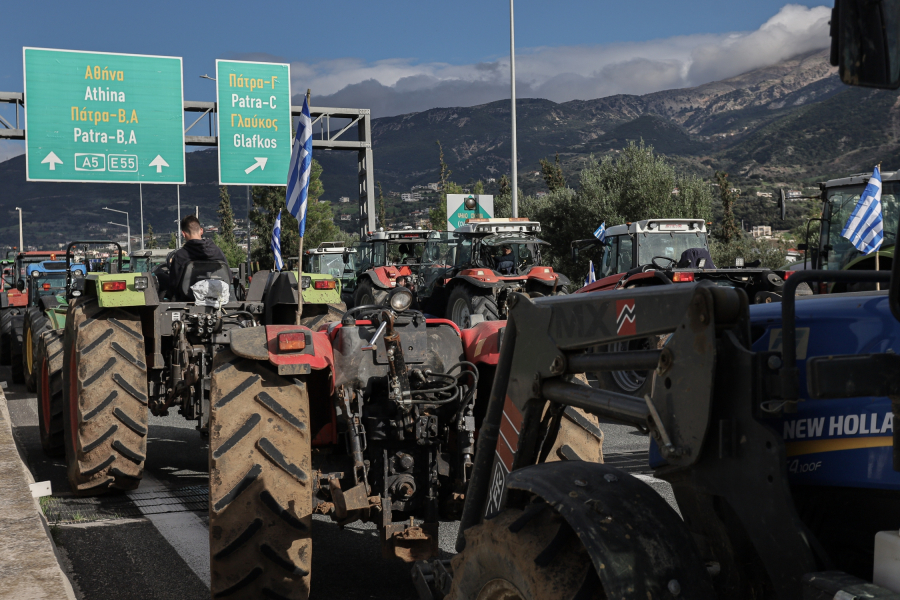
Greece’s business community is closely and anxiously following developments related to the ongoing farmers’ protests, acknowledging that the mobilisations stem from long-standing and structural challenges facing the country’s primary sector. This is stressed in a joint statement issued on Monday by four of Greece’s leading business organisations: the Hellenic Federation of Enterprises (SEV), the Hellenic Confederation of Commerce and Entrepreneurship (ESEE), the Greek Tourism Confederation (SETE) and the Federation of Industries of Greece (SBE).
In their statement, the organisations underline that Greek farmers are a vital and inseparable part of the national production chain, noting that the primary sector is deeply interconnected with industry, trade and tourism. They warn that any form of protest must take into account the particularly sensitive timing, as the fourth quarter of the year is critical for the economy due to the holiday season and its impact on consumption, tourism and industrial output.
Retail trade, they note, traditionally generates its highest annual turnover in the final quarter of the year, reaching around €19 billion last year. This year, however, performance during this period has become a matter of survival for thousands of businesses, as they struggle to absorb soaring operating costs and rely heavily on increased consumer spending during the festive season. Tourism businesses are also counting on the holiday period for a substantial share of their annual revenues, while winter tourism represents the main source of income for residents and enterprises in several regions affected by the farmers’ road blockades. For industry, the same period is decisive for completing orders, shaping annual financial results, sustaining export momentum and maintaining the country’s overall productive capacity.
The business groups stress that meeting these objectives requires the smooth functioning of markets, supply chains, transport and economic activity as a whole. Against this backdrop, they call on both the farming community and the government to return to dialogue, arguing that constructive talks are the safest way to resolve disputes and prevent their repercussions from spreading to other strategically important sectors of the economy. A responsible approach at this sensitive juncture, they argue, is one that preserves good-faith institutional dialogue, mutual respect and understanding, while avoiding serious disruptions to the broader economy.
Farmers, however, reacted critically to statements made earlier by Agriculture Minister Kostas Tsiaras, describing his remarks as vague and lacking concrete commitments. Consultations are now under way at protest sites across the country, with the Panhellenic Committee of Road Blockades expected to meet and formulate a collective response to the government. Speaking to local media, Giannis Koukoutsis, a representative of the coordination committee at the Nikaia blockade in central Greece, said that farmers would first confer nationwide before responding in a coordinated manner. While acknowledging that it was positive for the minister to concede that some of the farmers’ grievances are justified, he described the government’s stance as largely general and non-committal.
Earlier on Monday, Tsiaras presented what he called the government’s response to farmers’ demands, without outlining specific measures. He said the government and the Ministry of Rural Development and Food take the problems of the farming community seriously and have sought to maximise support through national funding and European resources, while recognising that significant challenges remain. According to the minister, several of the farmers’ demands are fair, reflecting mounting pressures from high production costs, international developments and the effects of climate change.
Tsiaras also said that the government has been in dialogue with farmers for months and reiterated its willingness to engage in substantive discussions on all outstanding issues, within the limits of the economy’s capacity and the European regulatory framework. He pointed to progress in recent months, including the normalisation of agricultural subsidy payments following disruptions last summer, and ongoing coordination with other ministries to address farmers’ concerns.
While stopping short of concrete pledges, the minister said there is scope to examine interventions aimed at easing production costs, stabilising and lowering electricity prices for farmers, addressing the cost of agricultural fuel, reforming Greece’s agricultural insurance system so that compensation fully covers insured losses, and providing targeted support to sectors under particular strain, such as livestock farming and certain crops. Any additional aid, he said, would come from unused funds under the European Union’s Common Agricultural Policy, following reforms and stricter controls in the subsidy payment system.
Concluding his remarks, Tsiaras called on farmers’ representatives to enter immediate and meaningful dialogue, arguing that a swift resolution would benefit not only the agricultural sector but society as a whole. He stressed that responsibility is expected both from the government and from those representing farmers, given the broader economic and social implications of the protests.