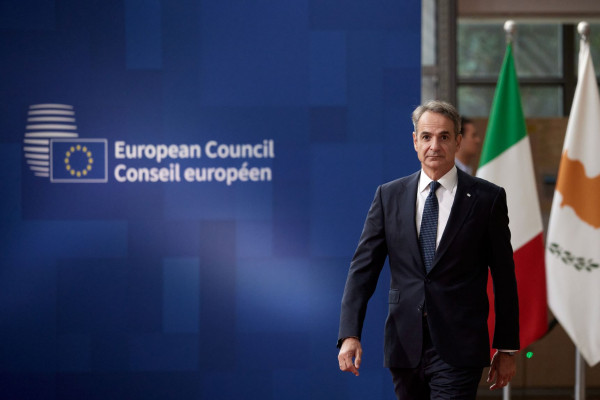

Greece’s government said political responsibility for the country’s long-running surveillance scandal was assumed through high-level resignations in 2022, as fresh allegations involving the Predator spyware renewed questions over the conduct and oversight of the National Intelligence Service.
Government spokesman Pavlos Marinakis made the comments after being asked whether Prime Minister Kyriakos Mitsotakis had sought a special briefing from Greece’s National Intelligence Service, known by its Greek initials EYP, following a criminal complaint filed by a serving senior intelligence official.
The official alleges that his phone was infected with Predator, sophisticated commercial spyware capable of extracting information from a targeted device. According to the complaint, the alleged intrusion amounted to espionage not only against the intelligence officer personally but potentially against the Greek state, raising questions about whether classified information was compromised.
ΔΙΑΒΑΣΤΕ ΕΠΙΣΗΣ


Marinakis didn’t directly answer whether Mitsotakis, under whose office EYP operates, had requested a detailed briefing on the allegations. Instead, he pointed to the institutional and legislative changes introduced after Greece’s surveillance controversy erupted in 2022.
“We have answered dozens of times—and, if I include the responses of other government officials and New Democracy lawmakers, hundreds of times—about the very significant institutional and legislative interventions undertaken since 2022, when the broader issue began, following the resignations that took place at the time,” Marinakis said.
The spokesman said additional security safeguards had since been introduced and the legal framework governing the intelligence service had been revised. He also referred to the “assumption of political responsibility” that took place several years ago.
The comments were a reference to the political fallout of August 2022, when the head of EYP and the prime minister’s chief of staff resigned as the surveillance controversy intensified.
The scandal became one of the most politically damaging episodes of Mitsotakis’s premiership after it emerged that opposition politician Nikos Androulakis, now leader of the socialist Pasok party, had been targeted with an attempted Predator infection and had also been subjected to separate surveillance by EYP.
The latest complaint threatens to reopen questions that have persisted for four years about the relationship, if any, between state surveillance and the use of Predator in Greece.
According to details presented during the government’s press briefing, the serving EYP official is asking judicial authorities to investigate whether previously unidentified individuals were behind the targeting of his device and to establish where information allegedly obtained through the spyware ultimately went.
Those allegations carry an additional national-security dimension because the target was himself a senior intelligence official. The possibility that information held by an EYP officer could have been extracted by spyware raises questions over whether sensitive or classified material may have been exposed.
Marinakis initially responded by stressing the separation of powers, saying the government doesn’t comment on pending judicial proceedings. He said political oversight of the intelligence service should not be confused with interference in the work of prosecutors and courts.
When reporters clarified that their question concerned Mitsotakis’s responsibilities as the political authority overseeing EYP rather than the judicial investigation, Marinakis again referred to reforms implemented since 2022.
“Security safeguards have been increased,” he said, adding that “national security is not under threat.”
He drew a distinction between the government’s institutional response to the surveillance controversy and the handling of the latest criminal complaint, which he described as exclusively a matter for the judiciary.
“The judiciary will resolve all of this,” Marinakis said. “We should learn to respect judicial decisions.”
The exchange nevertheless left a central question unanswered. Despite repeated inquiries, the government didn’t say whether Mitsotakis had specifically requested an internal EYP briefing on the allegations made by the intelligence official.
Nor did Marinakis say whether the intelligence service itself has investigated who ordered the alleged surveillance, on whose behalf it was conducted or where any information obtained from the targeted device might have ended up.