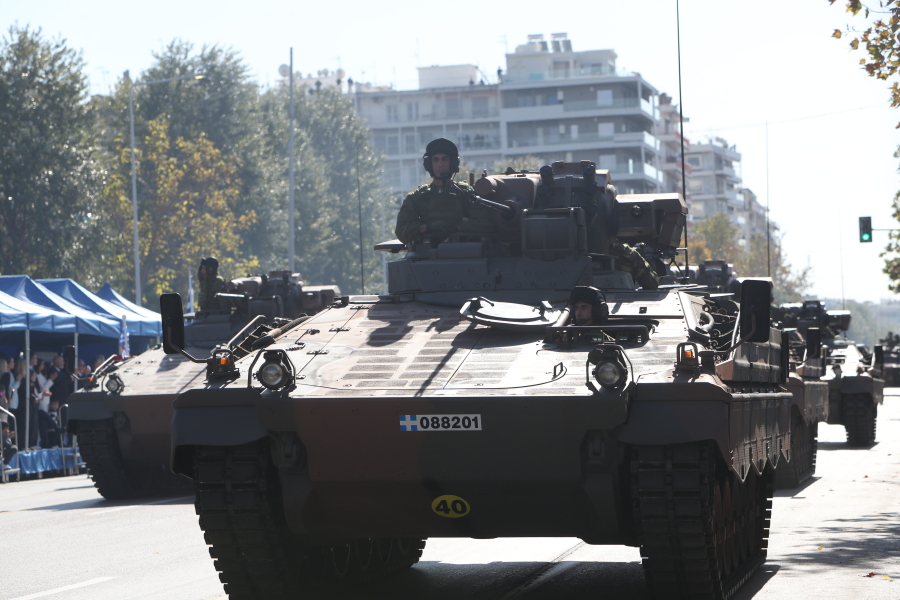

The Hellenic Army is preparing to launch a long-delayed modernization program for approximately 170 Leopard 2A4 main battle tanks, a move aimed at restoring the operational relevance of one of its most important armored assets. The upgrade will focus primarily on modernizing the tanks’ fire-control systems and enhancing their active protection capabilities, at a time when armored warfare lessons from Ukraine are reshaping military planning across Europe.
The Leopard 2A4 fleet, which entered service with the Hellenic Army in 2005, remains a central element of Greece’s land forces, particularly in the Evros region along the border with Turkey, where armored units form the backbone of deterrence. Despite their proven reliability, the tanks’ core systems have fallen behind contemporary standards. Their fire-control system is now inferior not only to that of the newer Leopard 2A6 HEL variant in Greek service, but even to the much older Leopard 1A5 tanks, which were inducted in the early 1990s and subsequently upgraded.
The modernization effort will be carried out domestically at METKA, reflecting Greece’s intention to leverage local industrial capacity and long-standing technical expertise in armored vehicle support. The company has sustained similar programs for foreign customers, including Norway, underscoring its ability to handle complex upgrades. In addition to a new fire-control system, the Leopard 2A4s are expected to receive enhancements to their active protection, complementing passive measures already introduced in response to battlefield lessons from Ukraine, such as the use of protective cages.
Greece maintains the largest tank fleet in Europe, with more than 850 Leopard tanks of various versions in service. When older U.S.-built M48 tanks are included, the total number of main battle tanks approaches 1,200. This extensive armored force is largely a legacy of decades of strategic rivalry with Turkey. However, while Ankara has systematically modernized its Leopard tanks—largely through its domestic defense industry—Greece allowed much of its armored fleet to stagnate for years, making even a limited upgrade program increasingly urgent.
The Leopard modernization initiative is also reviving a broader debate over the future of other German-designed systems in Greek service. In the coming years, attention is expected to shift to the upgrade of the Hellenic Navy’s Type 214 submarines, known as the Papapanikolis class, as well as to the possible acquisition of new boats. Germany has already put forward its 212CD submarine proposal, while France and South Korea are also competing. Israel, meanwhile, has submitted a complementary proposal involving unmanned underwater vehicles.