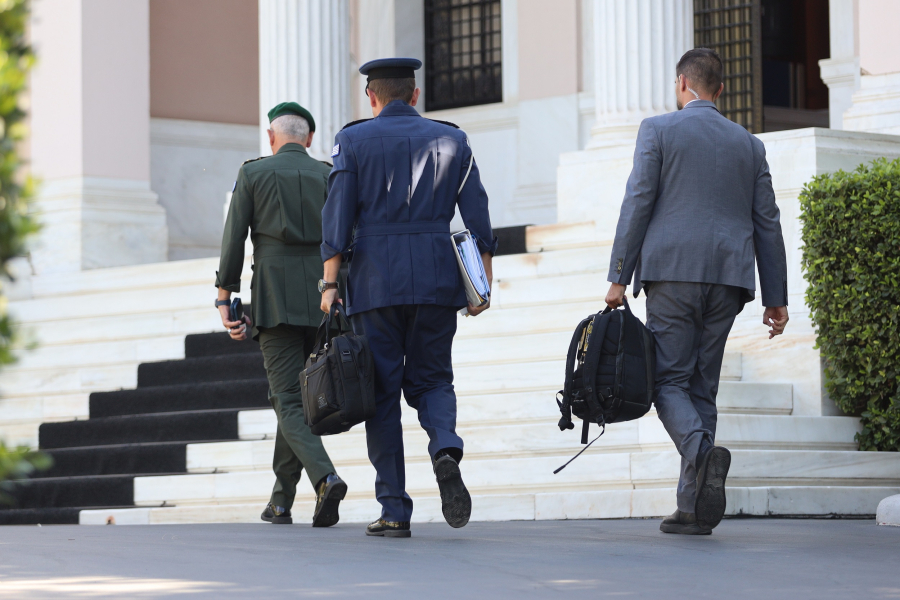

Greece’s Government Council for National Security (KYSEA) meets on Tuesday at the Maximos Mansion under Prime Minister Kyriakos Mitsotakis, in a session expected to shape the country’s medium-term defence posture. The agenda includes approval of Greece’s plan to modernise its artillery with Israel’s PULS multiple rocket launchers, alongside the ratification of several defence-procurement decisions already endorsed by Parliament. These span the acquisition of S-100 Camcopter unmanned helicopters for the new Belh@rra frigates and additional missiles for the RAM defence systems deployed on Greek missile boats. Once the government gives the green light, the decisions will undergo final scrutiny by the Court of Audit.
A key point of discussion is the PULS programme developed by Israel’s Elbit Systems. Athens and Jerusalem have agreed to a 30 percent Greek share in co-production, supported by a detailed roster of companies and subcomponents expected to participate. It remains unclear how much of this information will be made public or what will be disclosed about Elbit’s Greek partners. The deal’s lack of transparency prompted the PASOK party to vote against it in Parliament - an uncommon stance, as the party typically abstains rather than oppose defence-related votes outright.
Complicating matters for the government is a Belgian announcement on Monday that authorities have issued an international arrest warrant for 60-year-old businessman Eliaou Elouashvili. A resident of Israel holding an Italian passport, Elouashvili is suspected of acting on behalf of Elbit Systems in contracts under multinational investigation involving NATO’s Support and Procurement Agency (NSPA). Reporting by Le Soir, La Lettre, Follow the Money and Knack suggests he has been wanted since September 30 on charges of active bribery and participation in a criminal organisation. Investigators believe he operated through a network of companies in Lithuania, the United States, the United Kingdom, Romania and Greece, where he established a firm in late 2024, though the nature of his local partnerships remains unknown.
The case has already reverberated inside NATO. Over the summer, the NSPA froze fifteen contracts, thirteen of them linked to Elbit or its subsidiary Orion. These agreements involve munitions, propellant charges, countermeasure systems and aviation components, and include elements of a modernisation programme for Portuguese naval patrol vessels. Belgian investigators are also examining former NSPA officials who, after leaving the agency for the private sector, are suspected of leveraging their prior positions to facilitate Elbit-related contracts. The revelations have stirred unease in several European capitals, given Elbit’s central role in major NATO procurement programmes. Internal documents reportedly indicate the company could even face blacklisting by the NSPA.
Elbit maintains that no wrongdoing has been identified on its part in NSPA projects, stressing that the investigation concerns NATO’s procurement authority rather than the company itself, and says it is fully cooperating. Whether the Belgian probe will have repercussions for Greece is not yet clear. Elbit’s footprint in the country - including its role at the Kalamata military flight-training centre and its involvement in the Spike NLOS missile programme - has already attracted the attention of international investigative outlets. These developments add to the scrutiny surrounding Tuesday’s KYSEA meeting, which comes at a moment of heightened sensitivity over defence procurement and transparency.