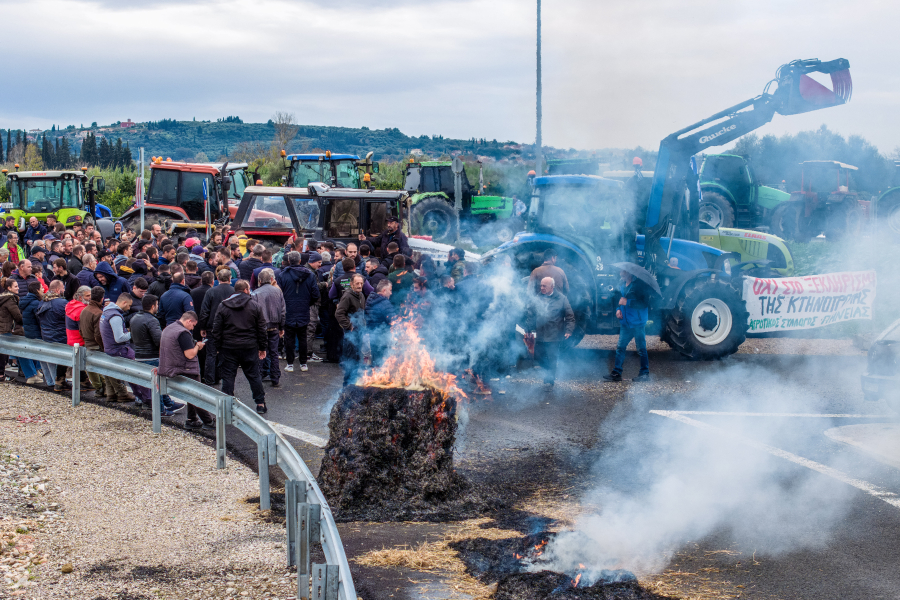

What began as frustration over delayed agricultural payments has expanded into a sweeping revolt against what participants view as a fundamentally misguided agricultural policy. The OPEKEPE scandal, involving alleged mismanagement at the agency responsible for distributing EU farm subsidies, has only intensified their anger.
The Thessalian plain, long the center of Greek agricultural activism, has once again emerged as the main coordination hub. Towns such as Nikea, Karditsa, and Trikala are hosting massive blockades, with more than 2,000 agricultural vehicles already gathered at key junctions. The border crossing at Evzoni, on the frontier with North Macedonia, has also been blocked, and similar disruptions are multiplying across the country.
Northern Greece is witnessing rapid escalation, with twelve separate blockades already established in the region. Tractors line the roads from Promachonas and Malgara to Chalkidona and Florina, where farmers have shut down the border crossing at Niki. A new blockade at the Siatista toll station is planned next, supported by farmers and breeders from Kozani, Grevena, Kastoria, Neapoli, and Amyntaio. Western Greece is joining gradually as well, with growing participation around Pyrgos and other areas of the Peloponnese.
Organizers aim to complete a nationwide map of blockades by Sunday. Representatives from across the country will then meet to determine the next phase of action. Among the options under serious consideration are the closure of major ports—including Thessaloniki—and potentially even airports, should the government maintain its current stance.
The mobilization has been marked by tense confrontations with police. Farmers in the Larissa area report unusually forceful attempts to prevent the first blockades from being established, with accounts of physical clashes, arrests, and the use of tear gas. Their determination, however, appears only to have grown. Supporters from various professions—truck drivers, construction workers, retail employees—have visited the blockades, expressing solidarity with agricultural workers whom they see as emblematic of wider economic hardship.
Personal stories from the protest sites highlight the depth of the crisis facing rural Greece. One young livestock breeder from Larissa recently had all 1,000 of his sheep slaughtered due to disease protocols, leaving him heavily indebted and unable to sustain his business. Others describe similar experiences, including injuries sustained while attempting to defend fellow farmers during clashes with police.
Behind the anger lies a broader structural crisis. Farmers point to soaring production costs that have left entire regions unplanted, because many can no longer afford to sow their fields. Market distortions have deepened their frustration: produce that leaves rural areas at minimal prices reaches urban markets at several times the cost, while producers see none of the benefit. Livestock breeders face an even more severe situation, as recurring outbreaks of sheep pox have led to extensive culling. Many argue that the government’s refusal to approve widespread vaccination has devastated herds and threatens to erase years of work. Rebuilding livestock capital, they warn, is a long and difficult process, and many fear they are on the verge of losing their remaining animals.
For many in the movement, the current upheaval reflects more than a dispute over agricultural payments. It represents a breaking point after years of financial pressure, policy failures and declining rural livelihoods. As Greece braces for potential shutdowns of ports and transport infrastructure, farmers appear resolved to continue their campaign indefinitely. The coming days will determine whether the government will engage with their demands or face an escalating national standoff.