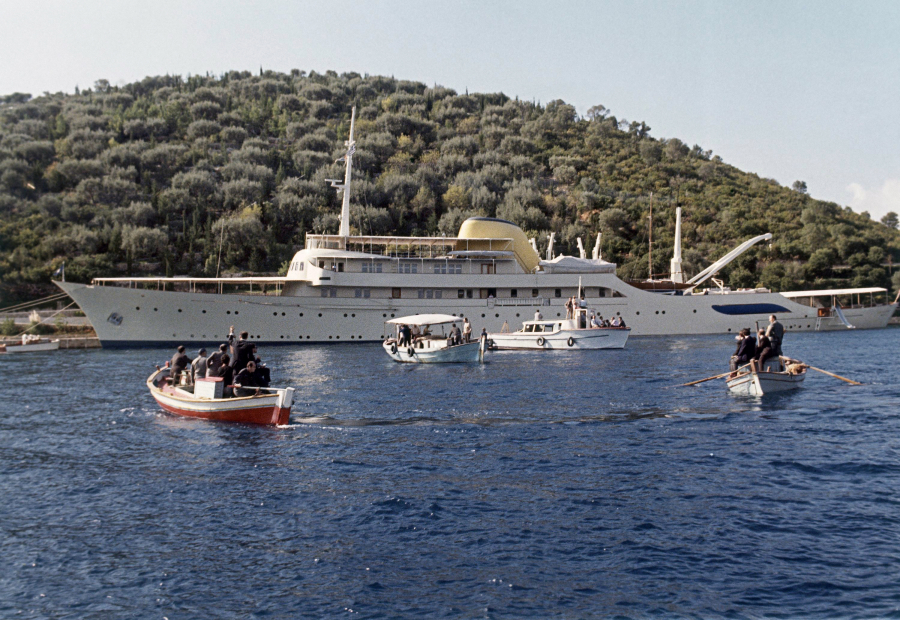
There are yachts, and then there is the Christina O — a vessel whose history is so steeped in power, glamour and intrigue that it has long transcended the category of luxury asset. Once the floating stage for the ambitions and social theatre of Aristotle Onassis, the yacht is again for sale, this time with an asking price of €52m, a notable reduction from the near €80m it sought as recently as March 2025.
Seen from above today, often captured in the sweeping clarity of drone footage, the Christina O still cuts an imposing figure. Moored and undergoing maintenance in Piraeus, it retains the proportions and poise of another era: long, low lines recalling its origins as a Second World War naval vessel, wide teak decks designed for spectacle, and the unmistakable silhouette of a yacht built not merely for leisure, but for display.
It is easy to forget that the Christina O began life in 1943 as a Canadian frigate. Its transformation into one of the most recognisable private yachts in the world was the result of Onassis’s singular vision — and deep pockets. He is said to have spent more than $4m, an extraordinary sum for the time, to refashion the warship into what became, in effect, a floating salon for the mid-century elite. Heads of state, Hollywood stars and business magnates passed through its decks, drawn as much by the man as by the setting.
What remains striking, more than half a century on, is how little of that aura has dissipated. The yacht’s interiors and exteriors have been repeatedly restored, yet they continue to project a kind of curated nostalgia — less a museum piece than a working relic of 20th-century excess. It still operates on the luxury charter market, an unusual status for a vessel of such provenance, balancing commercial use with historical significance.
The yacht’s journey after Onassis’s death has been as circuitous as its early life was glamorous. It passed first to his daughter, Christina Onassis, who later donated it to the Greek state. Renamed “Argo” and intended as a presidential vessel, it was barely used — a brief and largely symbolic chapter that underscored how difficult it was to repurpose something so closely tied to a singular personality. It would sail only once in that capacity, under President Christos Sartzetakis.
By 1998, the yacht had returned to private hands, acquired by entrepreneur John Papanicolaou, who reinstated its original name and restored its commercial viability. Subsequent sales — including a 2014 deal reportedly worth €25m — reflected both the enduring appeal and the complex valuation of such an asset. Today it belongs to Irish businessman Ivor Fitzpatrick, whose decision to sell marks the latest turn in its long, and often unpredictable, history.
That the Christina O is now priced significantly below its recent valuation speaks less to any decline in its intrinsic allure than to the realities of the global superyacht market. Vessels of this scale and singularity occupy a narrow niche, where provenance can both elevate and complicate a sale. It is, after all, not simply a yacht, but a piece of cultural history — one that carries with it the legacy of a man who understood, perhaps better than anyone of his era, how to turn wealth into spectacle.
For a prospective buyer, the appeal lies precisely in that paradox. The Christina O is at once an operational superyacht and a floating artefact, a place where the past remains palpably present. To own it is not merely to acquire a vessel, but to inherit a narrative — one that continues to unfold, somewhere between the blue of the Mediterranean and the mythology of a vanished age.